

Herring, Sir Edmund Francis ‘Ned’, born in Maryborough, 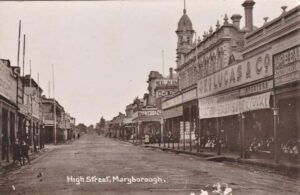 Victoria, on 02-09-1892, the son of Edmund Selwyn Herring (1862–1925) and his wife Gertrude Stella, born Featherstonhaugh Herring (1863–1949)
 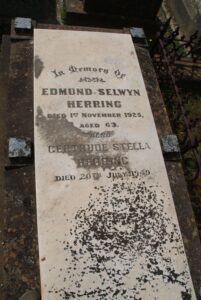 Edmund “Ned” the 3rd of five children, one brother wasbrother John Featherstonhaugh Herring (1889–1968). his father was employed as a solicitor. Edmund was married to Mary Ranken,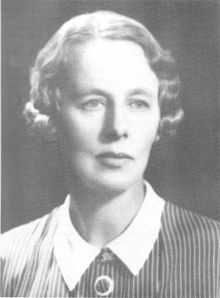
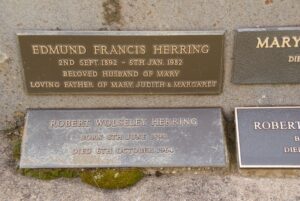
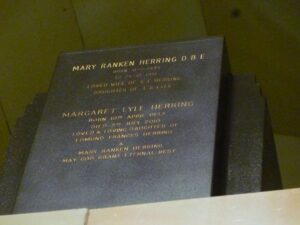 born Lyle Herring (1895–1981).she passed away in Springvale Botanical Cemetery Springvale, City of Greater Dandenong, Victoria, Australië. Section Renowden Chapel, Room 3, Section E, Niche 4..
Edmund began his secondary education at Maryborough High School. Then he received a scholarship to Melbourne Church of England Grammar School, where he was named dux of his year. After school, Edmund studied at the University of Melbourne.
In 1912, he received a Rhodes scholarship to study at Oxford University in England. 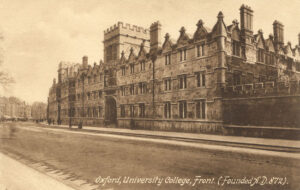 His studies were interrupted by World War I. He became a trooper in the British cavalry unit King Edward’s Horse.
 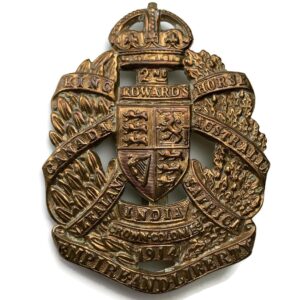 commanded by Lieutenant Colonel Victor Sandeman. During World War I he saw combat action on the Western Front in France and the Macedonian Front in southern Europe. After the end of World War I in November 1918, he remained in England and completed his studies at Oxford, graduating with a Bachelor of Civil Law Degree in July 1920 and returned to Australia to begin practicing law. In October 1922 he joined the Australian Army
  and was given the rank of captain. He continued to receive promotions and by August 1939 he was a temporary colonel, commanding the 3rd Division Artillery.
After the war, Edmund completed his studies at Oxford and returned to Australia in 1920. Back in Melbourne, Edmund had successful legal career and took an active role in politics. He also continued to serve as a senior officer in the part-time Citizen Forces.
Edmund married Mary Lyle, a clinical researcher and talented tennis player, in the Toorak Presbyterian Church on 6 April 1922. Mary was the daughter of Professor Thomas Ranken Lyle, a mathematical physicist who was scientific advisor to the Naval Board during World War I. In the 1930s, Edmund joined the secret anti-communist organisation, the White Guard,  which comprised former soldiers willing to act to suppress communist subversion.
When World War II broke out the following September 1939, he was promoted to the temporary rank of Major General and appointed Commander, Royal Artillery, of the 6th Division, 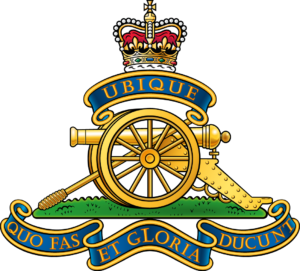 of the new 2nd Australian Imperial Force (AIF),
 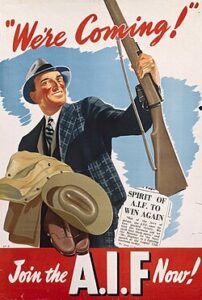 under command of Lieutenant General Thomas Albert Blamey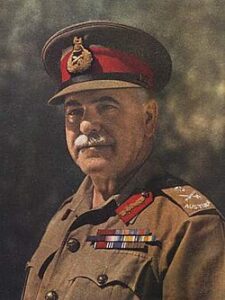
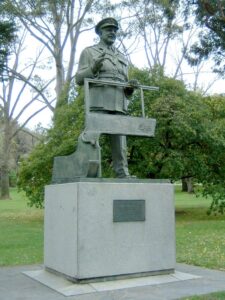 and assigned to North Africa where he participated in combat during the early stages of the Western Desert Campaign, including the Battle of Bardia in Libya (January 1941), followed by the Battle of Greece (April 1941). General Blamey passed away the following year 27-05-1951, form a cerebral hemorrhage at the age of 67. A statue in his honor resides in Kings Domain in Melbourne. Blamey Barracks at the Australian Army Recruit Center at Kapooka is also named in his honor.
In March 1942 Edward returned to Australia and was assigned command of the Northern Territory Force. The following August he was promoted to the rank of Lieutenant General and became commander of the Australian 2nd Corps 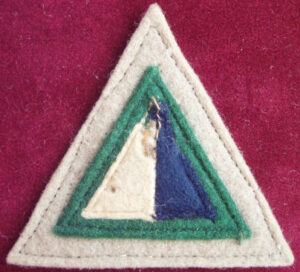 and assigned to Port Moresby in Papua, New Guinea. He was placed in command of the Australian 1st Corps
 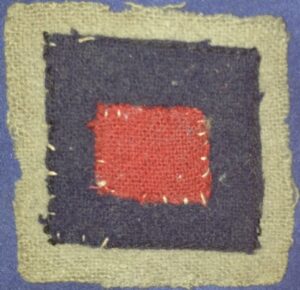 and he led his forces in combat action against the Japanese Army during the Kokoda Track campaign
 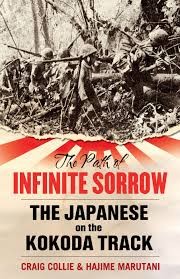 (July to November 1942), the Salamaua-Lae campaign (April to September 1943), the Huon Peninsula campaign (September 1943 to March 1944), and the Finisterre Range campaign (September 1943 to April 1944). He returned to Australia and appointed by the Victorian provincial government as Chief Justice of the Supreme Court of Victoria, serving in that position until 1964.
Death and burial ground of Herring, Sir Edmund Francis ‘Ned’.
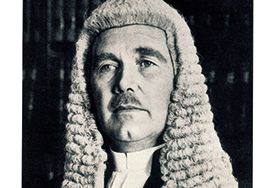
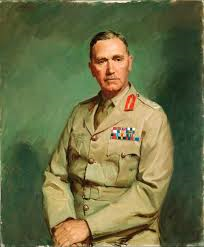
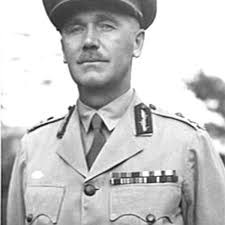
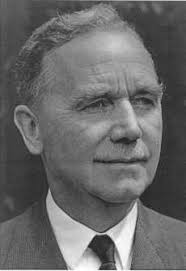
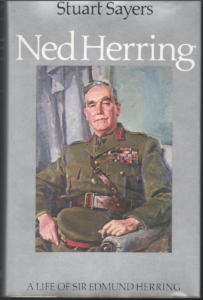
From 1945 until 1972 he also served concurrently as the lieutenant governor of Victoria. In August 1950 he was recalled to active duty for a year as Director General of Recruiting when the outbreak of the Korean War ignited new efforts to build up the Australian Army again. The following year he retired from the Australian Army with 29 years of continuous military service. His military and civilian honors and awards include the Knight Commander of the Order of St Michael and St George, 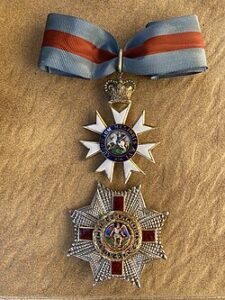 the Knight Commander of the Order of the British Empire,
 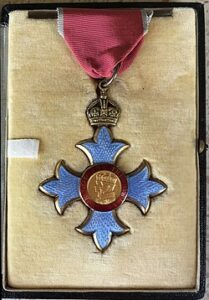 the Distinguished Service Order,
 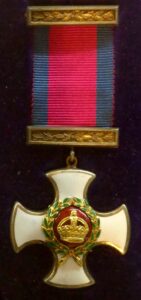 the British Military Cross,
 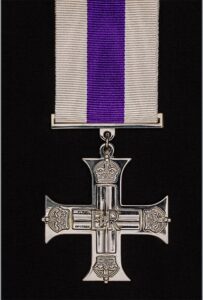 the Knight of the Order of the Hospital of Saint John of Jerusalem,
 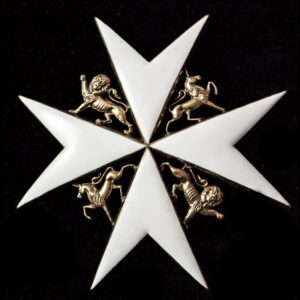 the Efficiency Decoration,
 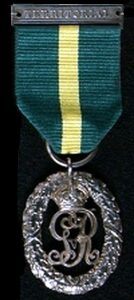 and the US Distinguished Service Cross.
 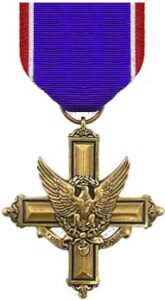 In 1953 he received an honorary Doctor of Civil Law (DCL)
  from Oxford University and in 1973 he was awarded an honorary DCL from Monash University at Melbourne. From 1959 until 1977 he served as the first president of the Australian Boy Scouts’ Association. Herring, Sir Edmund Francis ‘Ned’, died 05-01-1982 in Camberwell, City of Boroondara, Victoria, Australië, at the age of 89. A private service was held at the Springvale Crematorium on 11 January 1982. It was followed by a State Funeral at St Paul’s Cathedral for the former Lieutenant-Governor of Victoria (1945-72) and former Chief Justice of the Supreme Court of Victoria (1944-1964). Victoria’s Herring Island is named in his honor.




Leave a Reply