

Ven, Augestinus Everardis Maria “Guus” van de, born 01-05-1905, in Vlijmen Netherland,  the son of baker Harrie van de Ven and Cato, born van Susante. In August 1925, Guus traveled aboard the S.S. Vondel
 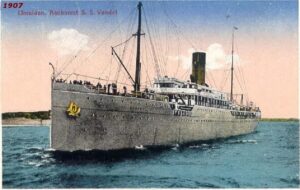 to the Dutch East Indies, where he was appointed as a “candidate governor of the Internal Administration” at the Bataviaasch Nieuwsblad newspaper.
  Presumably, this meant that Guus was being trained as a journalist and editor. On 27-05-1926, he married Jacoba Evers by proxy in ‘s-Hertogenbosch; his cousin Cornelis van de Ven from Vlijmen acted as proxy for the wedding ceremony. Two months later, Jacoba joined her husband in Batavia. They had two daughters, Else (1927) and Louise (1929). The marriage was dissolved in 1934, after which Jacoba was granted custody of her children. Marriage by proxy — commonly used in the colonies when the husband was already residing in the Dutch East Indies — meant that the wife could join her husband later; employers usually only paid for the passage after the marriage had taken place.
On 08-12-1941, one day after the attack on Pearl Harbor  , the Netherlands declared war on Japan in response; Japan seized the opportunity to immediately invade the Dutch East Indies. It came as no surprise. Because of its natural oil reserves and geostrategic location, Tokyo had long considered the conquest of the Dutch colony one of its most important goals in order to dominate East Asia.
Guus had previously volunteered for the Landstorm  , where he was assigned as a soldier to the coastal artillery of Tandjong Priok near Batavia. With the start of the Japanese invasion, Guus was conscripted into the KNIL and deployed to defend the colony. The Royal Netherlands East Indies Army (KNIL)
  motto: We are ready (Kami Adalah Sedia), was the Dutch army in the former colony of the Dutch East Indies. It officially existed from 1814 to 1950. The Dutch East Indies Army fell under the jurisdiction of the Ministry of Colonies and consisted of professional soldiers who were recruited both within and outside the Dutch East Indies.
After a three-month campaign, the Japanese have captured the archipelago’s most important strategic points and landed on Java. The KNIL, inadequately equipped and severely hampered by indecision at the top, stands no chance and surrenders in Bandung on 08-03-1942. Guus is taken prisoner that same day in the neighboring garrison town of Tjimahi and later transported to the camps. Together with thousands of other Dutch prisoners of war, he is deported to mainland Southeast Asia, where he is put to work as a forced laborer on the construction of the Burma Railway.  Guus endured an ordeal of more than 2,700 kilometers, traveling alternately in closed trains, by ship, truck, and on foot. He eventually ended up in the Thai camp Rintin,
  181 kilometers from the eastern end of the railway.
Rintin is located twenty kilometers north of Hellfire Pass and is one of the most notorious camps on the Burma Railway due to the extremely poor living conditions and the harsh work regime to which the prisoners are subjected. Working days of more than ten hours of extremely hard labor are becoming increasingly common. Meanwhile, the prisoners lacked almost everything. Food was severely inadequate, there were no medicines available, and hygiene conditions were very poor. Prisoners passing through on their way to other camps caused regular outbreaks of disease. Due to the high mortality rate caused by all these conditions, Rintin became known as a death camp. The exact numbers of victims in Rintin have not been documented, but it is estimated that tens of thousands of people died from violence, disease, exhaustion, and malnutrition.
Death and burial ground of van den Ven, Augustinus Everardis Maria “Guus”

In May 1943, after three months of operation, Rintin was closed due to a serious outbreak of dysentery. Guus, already severely weakened and exhausted by all the hardships, was one of the first victims. He died on 01-05-1943, at the age of 37 in Rintin and had initially a field grave near the camp and was later reburied at and found his final resting place at the Dutch military cemetery in Kanchanaburi on the River Kwai in Thailand. Section 5, Row E, Grave 22.
His name is also listed on the Roll of Honor for the Fallen 1940-1945  and on a plaque at the Three Pagodas Monument in Bronbeek.
  After the divorce, Jacoba and the daughters lived in Surabaya and were interned in Lampersarie, one of the largest camps for women and children, after the Japanese invasion. Lampersari was a civilian camp and reception camp in Central Java near Semarang. After Japan’s surrender in August 1945, the internment formally ended; the daughters went to the Netherlands to live with their grandparents in November 1946, Jacoba returned in 1949 and remarried in 1954. In short, the life story of Guus van de Ven illustrates how Dutch citizens became entangled in the deadly construction of the Burma Railway during the war years in the Dutch East Indies through military service and Japanese captivity, with lasting personal and family consequences.


Leave a Reply