


Bühler, Josef, born 16-02-1904 in Bad Waldsee, Landkreis Ravensburg,  Baden-Württemberg, Germany, the son of master baker Friedrich Bühler and his wife Maria Bühler, born Achilles. Josef was the eleventh child in a family of twelve children. Josef married Hedwig Almus (born 1920). The couple had two children: a daughter (born in 1943) and a son (born in 1945).
Josef attended boarding school and obtained his Abitur in 1922. He went on to study law at the universities in Munich, Kiel, Berlin and Erlangen. He earned a Doctor of Law degree and passed the state law examination in 1930.
Josef Bühler joined the NSDAP  , NSDAP-nr.: 1 663 751, in 1933, (membership number 1,663,751). That year, Bühler joined the Munich law firm of Frank, Hans Michael, the “Hangman of Czech nation”,
  who regularly defended Adolf Hitler and the Nazi Party
  in court. From this point on, his professional life was closely linked with that of Frank. On 01-10-1932, he was made a probationary judge at the Munich district court. As the Nazis grew more powerful, he became deputy president of the German Academy of Law.
Shortly after the Nazi seizure of power at the end of January 1933, Frank was appointed as the Minister of Justice for Bavaria on 10 March and Bühler became a member of his staff as a state attorney. He also was given a senior position in the National Socialist Association of German Legal Professionals. Bühler also joined Frank’s Academy for German Law, was made a member of its presidium and contributed articles to the academy journal.
In October 1934, after the process of Gleichschaltung (coordination) transferred sovereignty from the states to the central government, Bühler moved from Bavaria to become a prosecutor in the Reich Ministry of Justice in Berlin.  In 1935, he became the senior prosecutor at the Munich Oberlandesgericht (Higher Regional Court). After Frank was appointed as a minister without portfolio in Hitler’s cabinet, he brought Bühler into his ministerial office as a Ministerialrat (Ministerial Counselor) in 1938. Unlike many other high-ranking Nazi officials, Bühler was never a member of the SA
  or the SS
  .
.
Just before the outbreak of the war, Bühler was conscripted into the German Army in August 1939 but Frank obtained his release within days. After the invasion of Poland  by Nazi Germany in September 1939, Frank was appointed Governor General for the occupied Polish territories at the end of October
  and Bühler accompanied him to Kraków. On 8 December, he was made head of the Governor General’s office with the rank of Ministerialdirektor and, on 08-03-1940, he advanced to the position of State Secretary. After Arthur Seyss-Inquart,
 Frank’s Deputy Governor General, departed to become the Reichskommissar
  of the occupied Netherlands in May 1940, Bühler functioned as Frank’s deputy, a designation that was made permanent in June 1941. Though not given the formal title of Deputy Governor General, as State Secretary he was Frank’s chief deputy and represented him during his absences.
The meeting minutes of the Wannsee Conference identifying “Staatssekretär Dr. Bühler” as a participant.
Bühler attended the Wannsee Conference 
 on 20-01-1942 as the representative of the Governor General’s office. This conference was called to discuss the implementation of the Final Solution of the Jewish Question. The minutes of the meeting document Bühler stating that the General Government would welcome the launch of the Final Solution in its territory, and he stressed the importance of solving “the Jewish Question in the General Government as quickly as possible”. He also stated that “of the two-and-a-half million Jews concerned, the majority are unfit for work”. When his fellow conference participant Adolf Eichmann
 was asked at his 1961 trial in Israel what was meant by this statement, he answered that Bühler had wanted to intimate “that they should be killed”.
Bühler fled from Kraków back to Germany on 18-01-1945, the day before the Red Army  of Stalin, Josef “Koba” Vissarionovich,
  entered the city. He was arrested in Schrobenhausen on 30-05-1945 by American forces and interned in Nuremberg. He testified in Frank’s defense at the Nuremberg Trials on 23-04-1946, denying all knowledge of the Holocaust and trying to deflect all blame onto the SS, in particular, Reichsführer- Heinrich Himmler

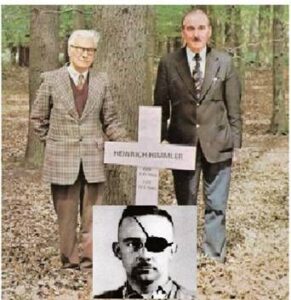
 and SS-Obergruppenführer Friedrich-Wilhelm Krüger,
  the Higher SS and Police Leader for the General Government.
Heinrich Himmler, visiting Krakow, March 1942. From left to right: As the Nazis grew more powerful, he became deputy president of the German Academy of Law. Friedrich Wilhelm Krüger, Himmler, Hans Frank and Josef Friedrich Bühler
Death and burial ground of Bühler, Josef.


Shortly afterward, on 25-05-1946, in accordance with the Moscow Declarations that established the principle that war criminals were to be transferred for trial to the nations where their crimes took place, Bühler was extradited to the Polish People’s Republic. His trial opened before the Supreme National Tribunal  on 17-06-1948. Bühler was found guilty on 10 July of crimes against peace, war crimes, and crimes against humanity. He was sentenced to death and ordered to forfeit all of his property. Clemency pleas were filed by Bühler, his attorney, his wife and Cardinal Michael von Faulhaber
 of Munich. All were rejected by Polish President Bolesław Bierut,
  and Bühler was executed by hanging on 22-08-1948, age 44, at Montelupich Prison in Kraków.
Bühler’s body was cremated and his ashes scattered at undisclosed location in Poland, by authorities, to prevent any tributes.
).


Leave a Reply