

Bastiaan, Jan Ader “Domie”, born 30-12-1909, in ‘s-Gravenzande,  as a boy was very interested in technology and wanted to be an engine driver. Jan was also considered adventurous, creative and musical. At the age of 17 he finished high school and then went on to study theology at Utrecht University
  for five years. During his student days, he cycled to Lochem on Sundays to play the organ at church services. In 1935 Ader married Johanna Adriana Appels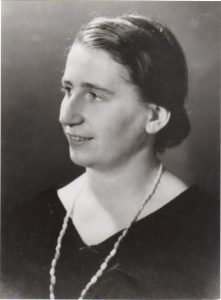
 from Driebergen. The couple had two sons: the later artist Bas Jan Ader (1942-1975)
  and Erik, who entered the diplomatic service,
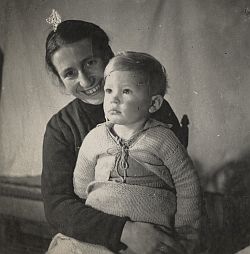 Johanna Adriana Appels was also a resistance women.
On 05-06-1936, Bas Ader embarked on a ” pilgrimage ” by bicycle to Palestine. On the way he contracted typhus from which he recovered, as did several falls. On November 20 he returned via Cairo, Greece and Italy by ship and train. The trip cost him a thousand guilders, which he then recouped by giving lectures about his trip.Two years later, Ader, nicknamed Domie (derived from Dominee, the Dutch term for priest), became a vicar in Nieuw-Beerta near Groningen, in a parish where many people had become alienated from the church because of the social differences between peasants and workers; many workers had turned to Communism. Through his organizational talent and his passion, Bastiaan knew how to inspire many, especially young people, for the church. From the beginning of the occupation of the Netherlands by the German Wehrmacht  , Johanna Adriana and Bastiaan Jan Ader became involved in the resistance, Since the beginning of the war, he worked in the resistance within the LO (Local Resistance). His resistance name was “Van Zaanen.” Their spacious vicarage became a hiding place for Jews, people in hiding, and Allied pilots; the spouses are said to have saved the lives of 200 to 300 people. Ader and his wife Johanna Adriana Ader-Appels even took in eight people in hiding and arranged for the hiding of many others, including the distribution coupon cards.The vicarage was repeatedly infested with mouse plagues, which was a common topic of conversation in the village. When casual visitors heard suspicious crackling noises in the parsonage, Ader explained to them, as was rumored, “Those are the mice. Bas Ader built up a network of resistance fighters. He developed a plan to liberate Jewish people from the Westerbork camp
  ; the plan was revealed. On 22-06-1944, Bastiaan was arrested and executed on 20-11-1944 on a hilltop near Rhenen, in the so-called Schupse Bos,
  with five other resistance fighters, in retaliation for shots fired at a German officer two days earlier. The five are – Pieter Julius ter Beek (23 years old)
  Victor Alexandre Guillaume van den Bergh (26 years old)
 Thomas Jan Lambrechtsen van Ritthem (24 years old)
  Philip de Leeuw (30 years old)
 Jan Johannes van der Munnik (20 years old)
  .
.
Ader was 34 years old and is buried on the Ereveld Loenen, Section Plot/row/number E 52, having first been buried in Driebergen. His wife Johanna, who had given birth to their second son Erik two weeks before his death, survived him by 50 years. The preacher Bastiaan Jan Ader, who was executed by the Nazis in 1944, was named a “Righteous among the Nations” in 1967 by Israel’s Yad Vashem Holocaust museum.
In the Northern Netherlands there is a “Bastiaan Jan Ader train” named after Ader.
In 2016, son Erik Ader  discovered that the forest, Adolam-France Park, had been planted by the Jewish National Fund on the site of the destroyed Palestinian village of Bayt Natiff,
  whose inhabitants had fled Jewish militias in 1948 and ended up in the Aida refugee camp near Bethlehem. The memorial stone lay in ruins. He denounced the JNF for ethnic cleansing and misuse of his father’s name. “I can’t ask my father what he thinks about his name being linked to this injustice, but knowing what he stood for, it’s not hard to guess,” he said. To give his father’s memory a different meaning, Erik donated 1,100 olive trees to the Palestinian village of Far’ata in the West Bank. Like many villages in occupied territory, it has suffered attacks by Jewish settlers on themselves and their olive trees. A plaque bearing Erik’s father’s name was also unveiled there. The inscription states that he “saved hundreds of lives during the Holocaust. Never again. For anyone. Nowhere.”Erik Ader also addresses the Netherlands. He says he is ashamed of his country “which has always accepted all violations of international law by Israel.” Ader: “We give tax benefits to the JNF, which even today continues to reforest stolen land.”


Leave a Reply