


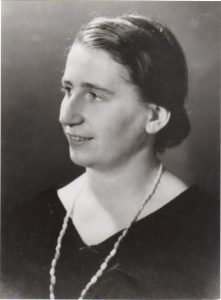
Appels, Johanna Adriana, married Ader, born 09-05-1906, in Driebergen,  Netherlands, as the youngest in a family with two brothers and two sisters of Dirk Appels (1856-1930), a contractor, and Johanna Adriana, born van Stam (1859-1931), a midwife. Johanna Appels married Bastiaan Jan Ader (1909-1944), a minister, on 25-09-1935, in Amsterdam.
  They had two sons, the later artist Bas Jan Ader (1942-1975) and Erik, who entered the diplomatic service .
After graduating from secondary school, Johanna obtained a MO certificate in English and went to work at an Amsterdam editorial office. In the early 1930s, she met theology student Bastiaan Ader 
 on a train, with whom she felt they shared a “Destiny” (Ader-Appels, 334). They married in 1935. A year later, Bastiaan obtained his bachelor’s degree and embarked on a months-long bicycle trip to Palestine; Johanna stayed home. For a short time (September 1937 to October 1938), Bastiaan was a Reformed assistant pastor in Haarlemmermeer-Badhoevedorp, after which he accepted a call from the Reformed Church of Nieuw-Beerta in Groningen. he Rev Bastiaan Jan Ader, under the pseudonym ‘Van Zaan’. also a reisitance man, who was executed by the Nazis on 20-11-1944, age 34 was named a “Righteous among the Nations” in 1967 by Israel’s Yad Vashem Holocaust museum.
  In retaliation for an attack on a German, he and five others were executed near Veenendaal on 20-11-1944, near the intersection of Oude Veense Grindweg and Veenendaalsestraatwet in Rhenen/Veenendaal. The six bodies remained behind and were buried two days later by residents of Veenendaal in the local cemetery. At the end of November 1944, he was reburied with his family in Driebergen. After the war, he was interred at the Loenen Field of Honor, where he rests in grave number 52, section E.
Johanna and Bastiaan Ader viewed their community as a domestic mission station. For example, the couple wanted to build a church center in the nearby hamlet of Drieborg to reclaim the workers drawn by the communists. Johanna organized youth work, catechism classes, and the women’s association. In 1941, she trained as a religious education teacher to assist her husband in his community work. In 1943, she made her debut under the pseudonym J.A. van Schagen with “Droomhanneke” (Droomhanneke) in the children’s story collection “Als deblaadjes vallen” (As the Leaves Fall).
In the summer of 1942, a few months after the birth of their first son, Johanna Ader-Appels received a letter from a Jewish friend in Amsterdam asking if she could join them. This Lilly Johanna Samuel  was the first of six permanent residents who found refuge with the Aders. The rectory in Nieuw-Beerta became a center for aid to Jews and pilots. Bastiaan Ader, along with several others, also devised an escape plan for Camp Westerbork,
  but he was betrayed by a former catechist before it could be carried out – he was forced into hiding in April 1944.
With her husband in hiding, Johanna Ader-Appels and her maid, Tantje, shared responsibility for the daily care of the people in hiding. They were arrested at Pentecost, but the police released them after a night. Her husband also remained active in the resistance. Ader-Appels moved the people into hiding elsewhere in Nieuw-Beerta, partly because her husband was wanted and she no longer trusted him. On 22-07-1944, Bastiaan was arrested in Haarlem. A month later, the Germans ordered Ader-Appels to leave the rectory. Given only half an hour to pack her belongings, Ader-Appels quickly threw out as many clothes as possible, an event that later (in 1970) inspired her son, Bas Jan, to create the artwork  Heavily pregnant, Ader-Appels left the parsonage, which was subsequently looted by the Germans. She stayed with farmers friends and colleagues in the neighborhood and received clandestine letters and poems from her husband. On 20-11-1944, sixteen days after the birth of their son Erik,
  Bastiaan Ader, age 34, was executed by firing squad in the woods near Rhenen.

During these turbulent times, writing was an important outlet for Johanna Ader-Appels. Her notebooks, hidden at a neighbor’s house, formed the basis for her 1945 war memoir, “A Groningen Parsonage in the Storm.” Another way to cope with the loss of her husband was her initiative to establish the Rev. Ader Fund: in early 1945, she proposed to the church council that this fund be established, which would eventually enable the construction of the small church in Drieborg her husband so fervently desired.
Death and burial ground of Appels, Johanna Adriana, married Ader.


On 31-07-1994, Johanna Ader-Appels died at the age of 88; she was buried in Nieuw-Beerta. J.F. Zijlkerstraat 10, 9687 PV Nieuw-Beerta.


Leave a Reply