


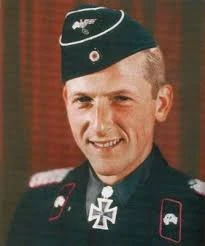
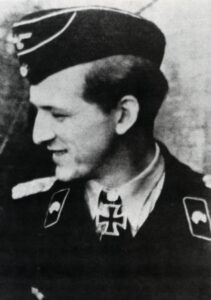
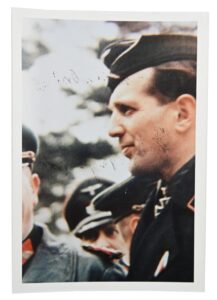
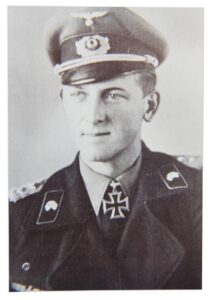
Kageneck, Clemens Heinrich Graf von, born 17-10-1913, in Berlin, 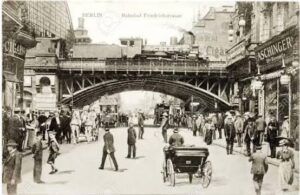 Germany, the oldest of four sons of Generalmajor Karl Graf von Kageneck
 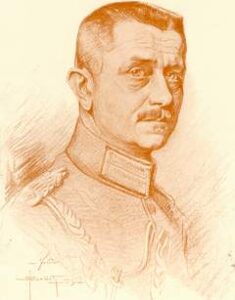 and his wife Freiin Maria von Schorlemer,
  daughter of Clemens Freiherr von Schorlemer,
 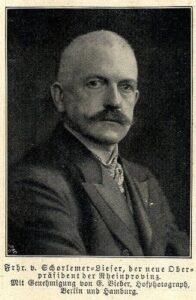 an Imperial Secretary of Agriculture. His brothers included:
Franz Joseph Graf von Kageneck (1915–1941), Princess Elisabeth Maria of Bavaria 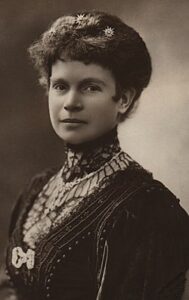 and Erbo Arbogast Graf von Kageneck (1918–1942),
 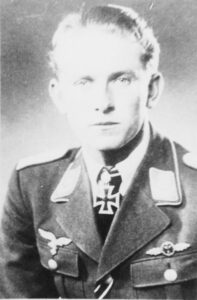 Luftwaffe pilot who was credited with 67 victories and August Graf von Kageneck (1922–2004),
 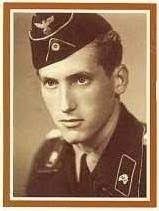 served as a lieutenant and a tank commander in the army, and was later a journalist and writer.
Clemens married Countess Caroline Henckel von Donnersmarck in 1944. The children are: Marie-Elisabeth Gräfin von Kageneck (born 1945), Franz Graf von Meran, Beatrix Gräfin von Kageneck (born 1946), Karl-Erbo Graf von Kageneck (born 1947).
Clemens Graf von Kageneck joined the 4th Cavalry Regiment  in 1934 and transferred to the 6th Company of the 6th Cavalry Regiment in October 1935. The 6th Cavalry Division (6. Kavallerie-Division) was a unit of the German Army that fought on Eastern and Western Fronts during World War I. The division was formed on the mobilization of the German Army in August 1914 and was disbanded in 1919 during the demobilization of the German Army after World War I.
Promoted to lieutenant in 1939, he participated as a platoon leader in the campaign in Poland and subsequently became the signals officer of the II. Battalion of his regiment, with which he took part in the Western campaign. After the Western Campaign, he was transferred to the staff of the 6th Panzer Regiment  under command of General Lieutenant Viktor Leopold Linnarzand
 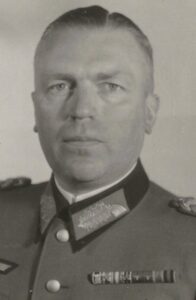 fought in Russia starting in June 1941. Linnarzand survived the war and passed away 14-10-1979, age 85 in Weiden in der Oberpfalz.
In March 1942, Kageneck was appointed as the commander of the 4th Company of the Panzer Regiment 6 as a first lieutenant. For repeatedly demonstrated bravery, he was awarded the German Cross in Gold  on 28-11-1942. In October 1942, he became the Chief Orderly Officer on the staff of the 3rd Panzer Division
  and was promoted to captain on 01-01-1943. In June 1943, he became the commander of the Heavy Tank Battalion 503.
  With this unit, he distinguished himself during Operation “Citadel” and in the battles north of Belgorod, for which he was awarded the Knight’s Cross
  on 04-08-1943.
Operation Citadel was the German offensive operation in July 1943 against Soviet forces in the Kursk salient, proposed by Generalfeldmarschall Erich von Manstein “The Pisspot Strategist”  during World War II on the Eastern Front that initiated the Battle of Kursk. The deliberate defensive operation that the Soviets implemented to repel the German offensive is referred to as the Kursk Strategic Defensive Operation. In these battles, he was wounded and, after his recovery in October 1943, took command of the Heavy Tank Battalion 503 again. At the end of 1943, he was severely wounded again and promoted to Major on 01-01-1944. On 24-06-1944, he was awarded the Oak Leaves
  for his leadership achievements. From October 1944 until the end of the war, he was the commander of a training group at the Panzertruppenschule Bergen and was taken prisoner at the end of the war.
Death and burial ground of Kageneck, Clemens Heinrich Graf von.
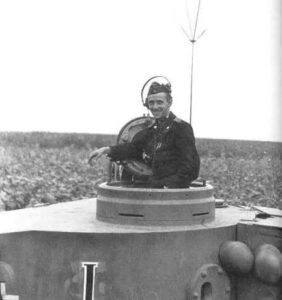
Clemens von Kageneck passes away 18-03-2005 (aged 91) in Bad Homburg, Germany and is buried at the Friedhof Bleichheim, Bleichheim, Emmendingen, Bleichtalstraße 1, 79336 Herbolzheim, Baden-Württemberg, Germany.



Leave a Reply