


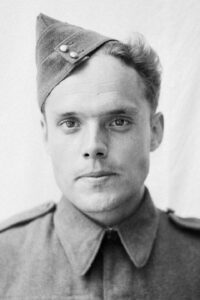
Tazelaar, Peter, “the Zeeuwse Soldier of Orange”, born 05-05-1920, in Fort de Kock (Nederlands-Indië),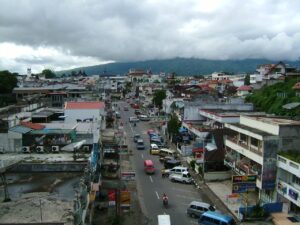 in the west of Sumatra. Peter spent his youth in the Dutch East Indies, where his father was a high-ranking official. Encouraged by his father, the 18-year-old Tazelaar enlisted as a cadet at the Royal Netherlands Naval College (KIM)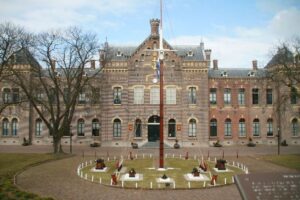
 in Den Helder. But he did not accept orders, so a career in the navy was not destined to last longer than one year of training. The only thing that appealed to him was the KIM adage chiselled into the wall, “Knowledge is power, character is more,” in the hall of the main building of Willemsoord: it comes down to mentality, not the stripes worn on the uniform. After his predictable failure as a naval cadet, he temporarily settled with family in Groningen and made some half-hearted attempts in merchant shipping. When the war broke out, he wanted to do something.
After returning to Groningen at the end of May 1940, Tazelaar came into contact with cadet Johan Birnie. 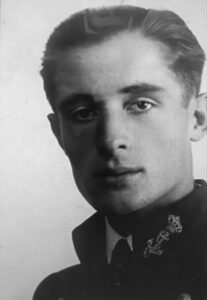 Because the Royal Institute of the Navy was closed, Birnie went to study medicine in Groningen. From the circles of naval cadets and officer cadets, a resistance group emerged in the summer of 1940, which would later merge into the Order Service.
He ended up with the Ordedienst (OD),  the resistance group of Uncle Alexander in The Hague, but the resistance also urgently needed contact with England. Tazelaar was given the assignment to go to London. “Uncle Alexander” (Oom Alexander) the resistance alias of Jonkheer Johan Schimmelpenninck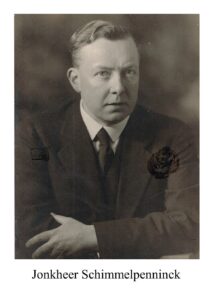
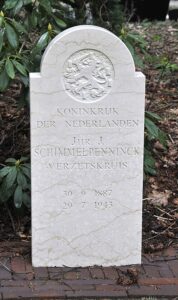 a Dutch wine merchant and resistance fighter based in The Hague. Through various channels, he managed to board the Swiss steamship St. Cerque,
 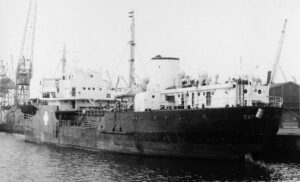 sailing under the Panamanian flag, on 02-06-1941. The 7,600-ton ship, measuring 222 meters in length, was docked in the Noorderhaven of Schiedam and was to load grain in New York for the Germans. The Latvian captain had no objection to signing on as a stoker. On board were also the Dutchmen Toon Buitendijk,
 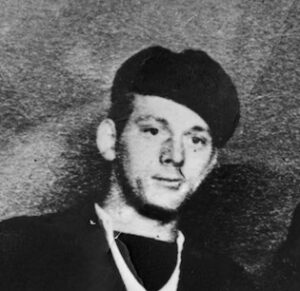 Erik Hazelhoff Roelfzema,
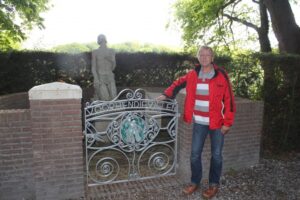 and Abraham Lamertus (Bram of Bob) van der Stok
  – the latter two being students from Leiden and members of the Minerva fraternity. They managed to set sail with the St. Cergue and, in doing so, escape the Nazis. Off the Scottish coast, the group boarded a British cruiser and after a short stay in the Danish Faroe Islands Islands – between Scotland and Iceland – the England sailors reached Great Britain. Erik, Bob, and Peter became the main characters in Contact Holland, which was wholeheartedly supported by the Dutch Queen Wilhelmina,
 a true mother abroad.
They could even move into the apartment next to Wilhelmina’s house. Van der Stok had devised a plan to land and pick up people in occupied Netherlands by boat. After arriving in England, Hazelhoff Roelfzema developed this plan and was tasked by Queen Wilhelmina and the British secret service to execute the plan under the name Contact Holland. The first agent to be landed by boat was Peter Tazelaar. He was landed at the pier of Scheveningen on 23-11-1941. Together with the previously parachuted radio operator Johannes Hermanus Arnoldus Maria “Jo” ter Laak, he was to establish a radio connection with the United Kingdom. On 07-09-1944, Jo is executed in the camp after horrific torture. He was 31 years old and left behind a widow with a child. Initially, little came of this because the radio transmitter had malfunctioned during the drop. With the identity papers and coins provided by London, Tazelaar couldn’t do anything: they were no longer in use in occupied Netherlands. Desperate, he sought contact with his former fellow cadet Gerard Adrianus Dogger, alias Klaas de Waard
 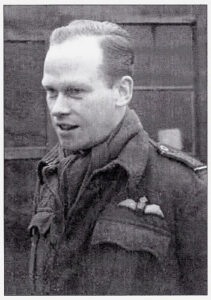 who had a network in the resistance, against his instructions. Thus, he came into contact with Aart Hendrik Alblas,
 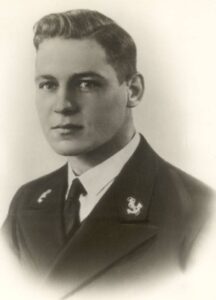 who did have a working transmitter. Alblas, age 25, was executed by firing squad in Mauthausen on 07-09-1944.
The second assignment of Tazelaar involved taking two important individuals to the United Kingdom. This also failed, because on 17-01-1942, the motorboat with Erik Hazelhof Roelfsema ended up in Katwijk instead of Scheveningen. In the failed operation, Herman Bernard Wiardi Beckmann 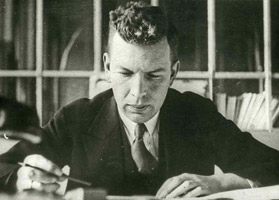 and Frans Johannes Goedhardt, nicknamed Stuuf
 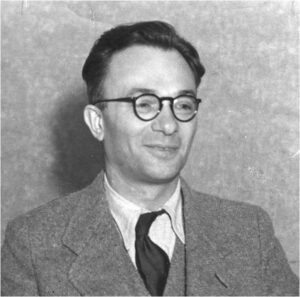 were arrested. Beckman on 15-03-1945, age 41, died in Dachau concentration camp. Frans Goedhardt survived the war and passed away on 03-03-1990 in Amsterdam, at the age of 86.
Now it became too dangerous for Tazelaar to stay in the Netherlands. At the end of January 1942, he left for Switzerland via the Van Niftrik route, together with Dogger, following a plan by Adrien ‘Broer’ Moonen. 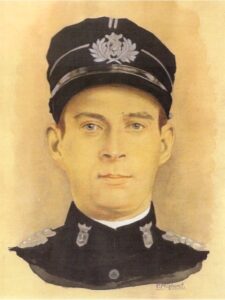
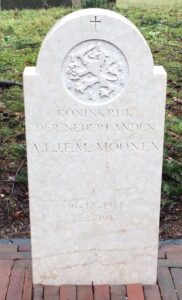 Via France, Spain, and Portugal, they reached the United Kingdom in April 1942. Back in London, he warned that the operation might have been infiltrated by the German secret service, but this warning was ignored by his superiors. After the war, it turned out that Tazelaar was right: almost all the agents sent out were arrested.
After returning to the United Kingdom, Tazelaar underwent commando training in Wales. In February 1943, he left for Canada to become an instructor with the Dutch troops. At the end of 1943, he returned to the United Kingdom. He joined the London Fire Brigade  and married an English woman, Dorothy “Door” “Dodie” Sherston.
 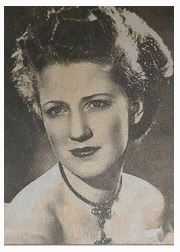 On 09-09-1944, Tazelaar received the highest military honour, the Military William Order,
 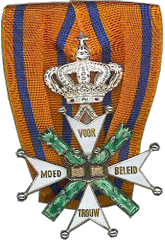 for his role in Contact Holland. He then joined the Bureau Bijzondere Opdrachten (BBO), a Dutch intelligence service that was established by the Dutch government during World War II, which parachuted agents into occupied Netherlands for sabotage and espionage missions. In November 1944, Tazelaar was dropped in Friesland along with Lykele Faber.
 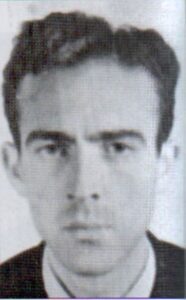 For half a year, they maintained radio contact with the United Kingdom. In March 1945, Faber and Tazelaar were caught by the Germans. Their boat sank in the process. The pair managed to escape and remained in Friesland until the end of the war, with some support from the British radio operator Alfred C. Springate. They were liberated by Canadian troops on April 21.
After the liberation of Friesland in April 1945, Tazelaar joined the Dutch headquarters in Southern Netherlands. He was appointed as an aide-de-camp to Queen Wilhelmina. Tazelaar was the one who informed Wilhelmina about the German capitulation. In film footage, he can be seen standing at the bottom of the aircraft stairs with Hazelhoff Roelfzema upon Wilhelmina’s arrival at Gilze-Rijen airport. 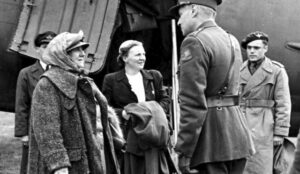
In August 1945, Tazelaar voluntarily left for Ceylon to participate in the fight against the Japanese, who, after their surrender in the Dutch East Indies, found no army to surrender to. As a result, the Japanese camps also remained intact. The plan of the Dutch Minister of War Johannes “Jo” Meynen 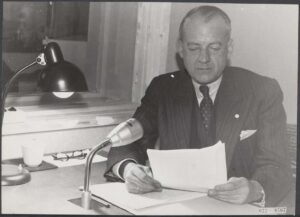 was to liberate those camps. Peter Tazelaar served in the same unit as Raymond Pierre Paul Westerling: nicknamed the Turk
 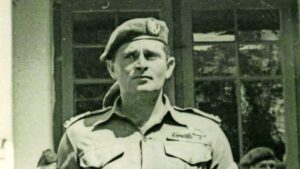 the British Force 136. S.O.E Admiral Lord Louis Francis Albert Victor Nicolas “Dickie” Mountbatten
 initially shelved the plans because he believed the Dutch had not performed well enough in the fight against the Japanese. The Japanese surrender had to be accepted by the Allies, not just by the handful of Dutch. Tazelaar then left on his own from Ceylon to the Dutch East Indies. His mother was interned there in a Japanese internment camp for women and children, Tjideng on Java.Tazelaar joined the military police and was involved in tracking down and interrogating Indonesian freedom fighters. In March 1946, he was injured, after which he returned to the Netherlands. That year, he married for the second time.
Death and burial ground of Tazelaar, Peter, “the Zeeuwse Soldier of Orange”.
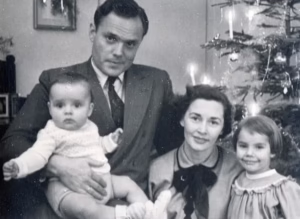
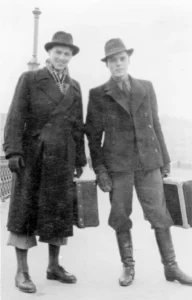
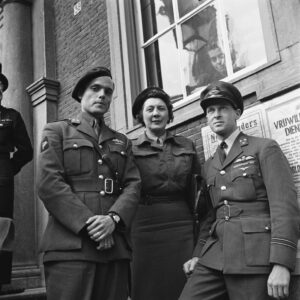
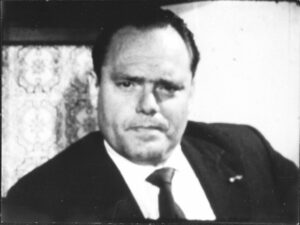
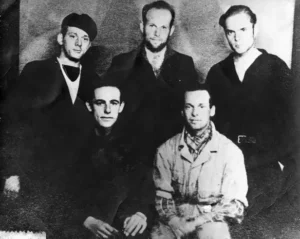
Tazelaar also led an adventurous life after the war. He operated as a spy behind the Iron Curtain during the Cold War. After that, he worked for KLM and Shell, among others. In total, he got married four times.
In 1981, Tazelaar moved to Hindeloopen, 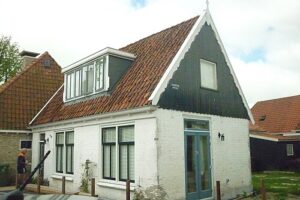 where he lived in a white house opposite a church. He had a sailboat, the Basilisk, and sailed the IJsselmeer and the Frisian waters. Peter Tazelaar passed away 06-06-1993, age 73, to the consequences of esophageal cancer, in Hindeloopen, Sudwest Fryslan Municipality, Friesland, Netherland.
Tazelaar was cremated at the crematorium on the Ockenburghstraat 1 in The Hague (Ockenburgh). His ashes were scattered at the time, which was customary.
Through the film Soldier of Orange, 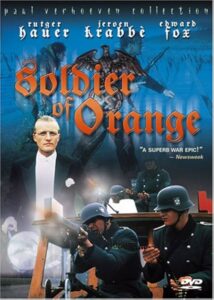 he was somewhat brought out of anonymity. In 2009, a biography about his life was published, written by the historian Victor Laurentius.
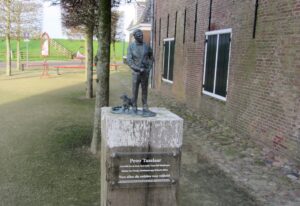
In Hindeloopen, a bronze statue of Tazelaar and his dog was unveiled on 23-06-2013. It was noted that he had passed away twenty years earlier. His daughter Eva, his son Peter, and his grandson Tjarda were present at the ceremony. 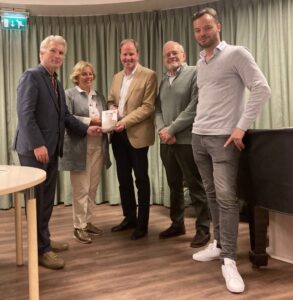 The statue is located at the Hidde Nijland Museum on Museumplein.


Leave a Reply