

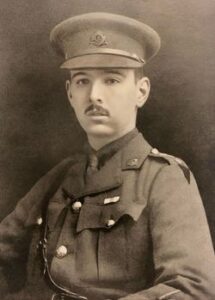
Kranenburg, Carel Hendrik “Cally”, nicknamed “The Hussar.” born 25-08-1917 in Huizen,  Netherlands, the son of Ferdinand Kranenburg and the American Eleanor, born Howell, spent his early years in Amsterdam, but in July 1928 the family moved to The Hague. He graduated from the Netherlands Lyceum on Willemstraat
 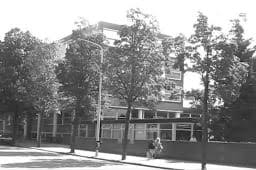 and completed his military service in the Royal Netherlands Army.
  He received officer training in the cavalry in Amersfoort.
In 1938, he left for Hungary as a reserve officer to participate in the fight against the Germans. He was promoted to cornet and returned to Amersfoort to fight the Germans from there as well. He became commander of the 3rd Platoon, 3rd Squadron, 1st Hussar Regiment,  and on 12-05-1940, he and several volunteers were ordered to cycle to Barneveld to search for any prisoners, fallen soldiers, or equipment. Near Nijkerk, they encountered Germans, who initially fired upon them and later captured them. He was released on 09-06-1940. Carl joined the resistance and was nicknamed “The Hussar.” On 13-08-1940, he, Erik Michielsen,
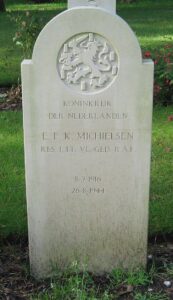 and resistance man Jean Mesritz
  who died died at the age of 27 on 31-03-1945 in Neuengamme war camp, attempted to hijack the SCH 107
  to cross to England, but the Germans had seized the lugger, and the plan was canceled. On the night of 13-10-1941, he attempted to return to England. Heije Schaper, a Dutch soldier and politician
  was supposed to pick up his group at Tjeukemeer lake. However, they were reported by a farmer. Schaper was flying the Dutch Naval Air Service seaplane; he was shot at but managed to escape. Schaper survived the war and passed away in the Hague, 26-05-1996, age 89. The group consisted of Lodewijk Anne Rinse Jetse (Lodo) van Hamel,
 Johannes Floris Philippus (Hans) Hers (Ridderkerk, 04-07-1917 – Oegstgeest, 29-10-2006)
  was a Dutch doctor and resistance fighter, Jean Mesritz, Marion Smit,
 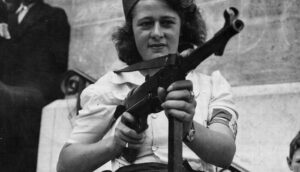 and Lourens Gerhard Marinus Baas Becking a Dutch botanist and microbiologist.
  who survived the war and passed away on 06-01-1963, age 68, in Canberra, Australia. They were arrested and taken to the Oranjehotel.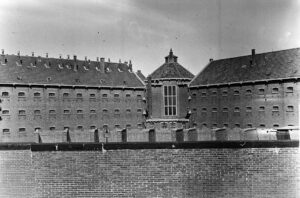
 In April 1941, they were tried by the Kriegsgericht (Civil Court) in Utrecht. Van Hamel was sentenced to death, Hers to life imprisonment, Baas Becking to a short sentence, and Kranenburg was arrested on 16-04-1941.
After his release, he joined the Dutch Interior Forces  as an officer, Region 10 Amsterdam, Field Security Investigation Department. The Dutch East Indies (Malay: Hindia-Belanda, old spelling: Nederlandsch-Indië) was the official name used from 1816 until its transfer in 1949 for the colony of the Netherlands that eventually included present-day Indonesia.
There, too, he became a platoon commander.Dutch East Indies. On 20-07-1945, Kranenburg was seconded to the Marine Corps. He received military training in Scotland and was then trained as an officer in the Marine Brigade at Camp Lejeune in the United States. On November 17, he departed for the Dutch East Indies aboard the MS Noordam II,  still in Army service and seconded to the Navy. The Noordam was the second ship of that name operated by the Holland America Line (HAL).
  It was a freighter, but even before the war, it could accommodate 125 passengers.
Carel arrived in Java on 10-03-1946. He participated in the police actions  and became commander of the armored car spearhead during Operation Voorloper. In 1947, the Nakba and the Dutch Police Actions took place, both major conflicts with international consequences. The Nakba was the expulsion of Palestinians from their homes, which began around the end of 1947, while the Police Actions were Dutch military operations to prevent Indonesian independence.
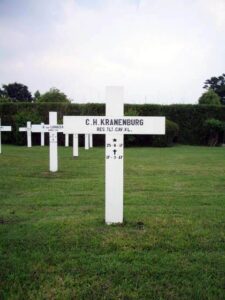
Death and burial ground of Kranenburg, Carel Hendrik “Cally”.

On 17-03-1947, his platoon went to the locks at Milrip to occupy them. En route, the armored car Kranenburg was in was attacked. When his gun malfunctioned, he opened the turret hatch to fire at the enemy with his Tommy gun.  This proved fatal; he destroyed his attacker but was himself struck by a bullet. Carel died instantly. After the capture of Mojokerto, he was buried there. Kranenburg was later reburied at the Dutch War Cemetery Kembang Kuning in Surabaya.





Leave a Reply