


Vietinghoff genannt Scheel, Heinrich Gottfried Otto Richard von, born 06-12-1887 in Mainz am Rhein  , Baden.
, Baden.His military career was strongly supported by his parents, Artillery Generalleutnant Heinrich Otto Konrad von Vietinghoff genannt Scheel (1857–1917)  and Leona Gräfin von Vietinghoff genannt Scheel (born von Schmettow) (1861–1942)
  . Heinrich joined the army at the age of 15, where he lied about his age in the first few years.
and Leona Gräfin von Vietinghoff genannt Scheel (born von Schmettow) (1861–1942) . Heinrich joined the army at the age of 15, where he lied about his age in the first few years.Vietinghoff married the widow Elfriede Wagner (born 07-03-1892 in Hanover, Germany, 04-02-1989 in Munich), the daughter of Oberst Ludwig Wagner and Marie Schwarzmann. The marriage resulted in two children, a daughter (born 1921) and a son (died 1926). His wife had been married to the factory director Adolf Schwarzmann in his first marriage (29-04-1911 in Strasbourg), but he had died in Stuttgart just under 16 months after the wedding on 05-08-1912. After being promoted to leutnant on 27-01-1907, Heinrich was employed in the First World War and rose to the rank of Hauptmannn.
On 24-11-1938, von Vietinghoff was appointed commander of the 5th Panzer Division  and took part in the invasion of Poland under Wilhelm Ritter von Leeb.
 He was promoted to General
  in June 1940 after which he led the German XLVI Panzer Corps in the invasion of Yugoslavia.
 During Operation Barbarossa
  his corps was part of Army Group Centre under Generalfeldmarschall, Fedor von Bock.
and took part in the invasion of Poland under Wilhelm Ritter von Leeb. He was promoted to General in June 1940 after which he led the German XLVI Panzer Corps in the invasion of Yugoslavia. During Operation Barbarossa his corps was part of Army Group Centre under Generalfeldmarschall, Fedor von Bock.
 The 91.000 German POWs taken at Stalingrad
  , 27.000 died within weeks and only 5-6,000 returned to Germany by 1955. The remainder of the POWs died in Soviet captivity. On 02-02-1943, the organized resistance of Axis troops in Stalingrad ceased. Out of the 91.000 prisoners taken by the Soviets, 3.000 were Romanian. These were the survivors of the 20th Infantry Division
  , 1st Cavalry Division
  and “Colonel Voicu” Detachment. According to archival figures, the Red Army suffered a total of 1.129.619 total casualties; 478.741 men killed or missing and 650.878 wounded. These numbers are for the whole Don region; in the city itself 750.000 were killed, captured, or wounded. Anywhere from 25.000 to 40.000 Soviet civilians died in Stalingrad and its suburbs during a single week of aerial bombing by Luftflotte 4 as the German 4th Panzer
  under command of Generalleutnant Erich Schneider
  and 6th Armies, under General Paulus
  approached the city; the total number of civilians killed in the regions outside the city is unknown. In all, the battle resulted in an estimated total of 1.7-2 million Axis and Soviet casualties. In this time, Vietinghoff had an accident after which he got his nickname “Panzerknacker” (“Tank breaker ) Von Vietinghoff also later served with Generaloberst der Panzertruppe, Heinz Wilhem Guderian

 in the German Second Panzer Army
  . Generalleutnant Erich Schneider survived the war and died 03-08-1980, aged 85, in Wiesbaden. From December 1941 to August 1943 von Vietinghof was Commander-in-Chief of the German Fifteenth Army in France, The HQ of the 15th Army is today a museum in Tourcoing, near Lille in northern France, Musée du 5 Juin 1944
  . In Italy from August 1943 onwards he commanded German Tenth Army, which was responsible for the telling delaying actions through the successive defensive lines built across Italy. Notable in this context were the defenses on the Winter Line from November 1943 to May 1944 and the fighting in the autumn of 1944 on the Gothic Line. In October 1944 he was temporarily raised to overall command in Italy (Army Group C) when General Field Marshall der Flieger, Albert Kesselring was seriously injured in a car crash.

In January 1945, on Kesselring’s return, he left Italy to command Army Group Courland in East Prussia. When Kesselring was moved in March 1945 to command German Army Command West (OB West) in France, von Vietinghoff returned as the supreme German commander in Italy. In April 1945 his son Heinz Dieter was MIA, age 29. At the end of April 1945, he made contact with the Allied forces and on April 29, his representative SS Obergruppenführer, SS and Polizei Führer in Italy. Adjutant of Himmler, Karl Wolff

 signed on his behalf at the Royal Palace in Caserta, that he agreed to surrender his troops on 02-05-1945 at noon. Von Vietinghoff here questioned by US Captain Ralph C Opperman
  , interpreter for Lieutenant Lucian Truscott,
 Commander 3rd Infantry Division
  following the the German surrender. Afterwards he spent two and a half years in British captivity at Bridgend Island Farm (Special Camp XI) among numerous other German prisoners of war. He was released in September 1947. After the war von Vietinghoff was a member of the expert group dealing with the question of German rearmament.Here with Generaloberst Gotthard Heinrici

 In October 1950 he wrote the Himmer oder memorandum on behalf of the Konrad Adenauer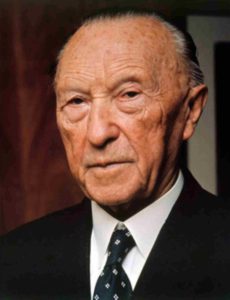
 government, on West German contributions to European defense.
Death and burial ground of Vietinghoff genannt Scheel, Heinrich Gottfried Otto Richard von.


 He died on 23-02-1952, age 64, in Pfronten and is buried with his wife Elfride, born Wagner, who died at the very old age of 96, on 04-02-1989, on the Stadtfriedhof of Pfrontenried-Berg.


Leave a Reply