

Desmon Byrne Snape, “Des” born 04-05-1923, in Abbotsford in the Australian state of New South Wales.  Before entering the service, Desmon worked in the store of the large radio factory of the Amalgamated Wireless (AWA)
  company in Ashfield near Sydney. Desmon was a pleasant friendly boy with brown hair, blue eyes, height 1.71m and a weight of 57 kg. On 30-06-1941, Desmon enlisted in Sydney at recruitment center number 2 for the Air Force.
  The Air Force desperately needed personnel and ran an advertising campaign under the slogan “join the RAAF, this is a man’s job! After a rigorous all-day medical examination, he was found fit to become a pilot. He was admitted to the reserve and on 10-10-1941 he was called to active duty, ‘for the duration of the war and a period of 12 months thereafter’. He was then 18 years and 5 months. After 12 weeks of basic flight training and then 14 weeks of training, Desmon was ready to be embarked.
  Desmon went to Sandgate, near Brisbane. Desmon left on 17-06-1942 by ship for Canada, where he would receive the remainder of his flight training. In 1939, the British Commonwealth, which included Australia and Canada, had determined that most of Australia’s aircrew would be trained domestically. A small proportion would receive training after basic training in another part of the British Commonwealth. Often this was in Canada, where there were many flying schools.Desmon arrived on 09-08-1942 at Lachine, a Canadian Air Force (RCAF)
  transit camp, in a western suburb of Montreal, after a journey of nearly two months that had also taken him through the Panama Canal. On August 16, he arrived in Calgary, at the 3 Service Flying Training School.
  In early December, Desmon made it there to Airman Pilot, the rank of sergeant.
All Allied transports from Canada to England departed from Halifax: a total of 494,874 soldiers headed for Europe from here, 50,000 of whom would never return. Desmon left on Tuesday, 29-12-1942, on a large and fast troop transport ship, which was often a former luxury cruise ship. Such a journey across the Atlantic was no fun: many people suffered from seasickness and there was a constant threat of the many lurking German U-boats eager to torpedo Allied ships. Fortunately, most large transport ships were too fast for the U-boats.The ship sailed for Liverpool. From there the journey was by train to Bournemouth, where all the Australians from Canada were gathered, then distributed to airfields in England for their further training. The Bournemouth Blitz on 23-05-1943 was the heavy bombing of Bournemouth, Hampshire (but now in Dorset), England from 1940 to 1944, by the Nazi German Luftwaffe  during the Second World War. More than 2,200 bombs fell on Bournemouth and Poole during World War II, and 350 civilians and servicemen were killed.
Australians made up about 9% of the total number of RAF aircrew. From Bournemouth, Desmon went to RAF Station Grantham airbase, in Lincolnshire,  where he arrived on Tuesday, 16-03-1943. Here Desmon met his later buddy Ian “Rusty” Hamilton Fowler,
 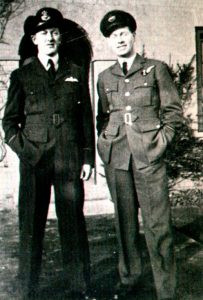 a Canadian Flight Lieutenant from the RCAF (pictured right). Because of his red hair, Ian was also known as “Rusty. The two men happened to become a duo and ended up flying together for almost a year. Ian Fowler crashed 25-02-1944. On 04-06-1943, Desmon was promoted to Flight Sergeant.
On 15-06-1943, Desmon and Ian were transferred to Church Fenton Air Base in North Yorkshire,  where they learned to handle a night fighter; a fighter to shoot down other aircraft at night. Here they learned to fly the newest aircraft: the De Havilland 98 Mosquito NF II.
  This extraordinarily fast aircraft, also called the wooden wonder because of its balsa wood and plywood fuselage, would become Des and Ian’s definitive plane. After training as night fighter pilots, both men were transferred to the 141 Squadron of the Royal Air Force.
 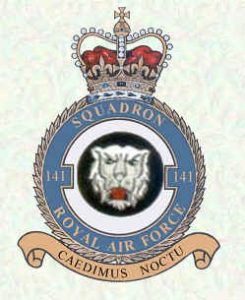 Their motto was Caedimus Noctu: “we hunt at night. The 141 Squadron had been created specifically to use state-of-the-art radar equipment to protect Allied bombers from German night fighters
Des and Ian’s wooden wonder had a heated cockpit and was equipped with several antennas that allowed it to pick up signals from German aircraft. The pilot sat on the left side of the cockpit and his observer/radar operator sat on the right, slightly to the rear.The Mosquito was mainly used where German night fighters gathered to wait for British bombers. They had to shoot down the German planes before they had a chance to hit an Allied plane. With its special antennas, the Mosquito could detect German planes up to 100 miles away, then fly behind them and shoot them down.
One downside of the Mosquito was the cramped (emergency) door where the crew had to get in and out. On the inside of the door was written in large red letters ‘Beware of Airscrews’: it was right behind the propeller of the right engine, so in case of ‘disembarking on the way’, it was important not to go to the front, but when disembarking, to jump directly to the back. With a lot of wind, caused in part by the propeller, this was quite difficult! In an emergency, the observer sitting right next to the door had to be the first to exit the plane by pulling the red lever on the door. This lifted the door from its hinges to fall down, after which the observer could jump. Only then could the pilot also jump out of the plane. Des and Ian made many night flights with their black-painted aircraft. On 21-01-1944, for example, they made a flight toward Magdeburg in Germany. They flew along among the British Lancaster bombers. During that night, a Junkers 88  night fighter was active, shooting down four Lancasters in succession. As the German pilot was in the process of shooting down his fifth plane, the guns of Desmon and Ian’s Mosquito hit his plane. The Junker did not crash immediately, but was so badly damaged that the crew had to jump out. The pilot, Heinrich Alexander Ludwig Peter Prinz zu Sayn-Wittgenstein,
  jumped last. He remained attached to the plane with his still unopened parachute, which then crashed over Brandenburg. Without knowing it, Des and Ian had shot down one of the most decorated (by Adolf Hitler
  personally!) German night fighter pilots during their flight. During his career, this German pilot managed to shoot down as many as 83 Allied aircraft. Only afterwards was it established that Des and Ian had shot this man down. They only reported having damaged one plane.
More than a month later, on Thursday, 24-02-1944, Des and Ian flew another mission. This time they were conducting a diversionary operation with five Mosquitos toward Kiel, the Danish Kattegat and the Little Belt. The intention was to divert attention from the real attack: that on the important German ball bearing factories in Schweinfurt. Des and Ian took off at 5:58 p.m. from their West Raynham base in Norfolk toward Helgoland. They were flying at an altitude of 18,000 feet. Along the way, they encountered no enemy aircraft. Des turned around and at that moment Ian detected a German aircraft on radar, flying toward the German mainland. As they caught sight of it flying at full speed and were right behind it to shoot it down, their right engine ran hot from overheating. It lost all its coolant after five minutes and exploded.
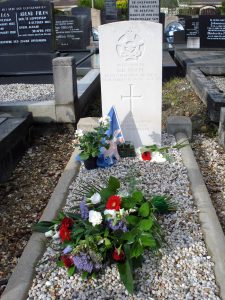
Death and burial ground of Snape, Desmon Byrne “Des”.
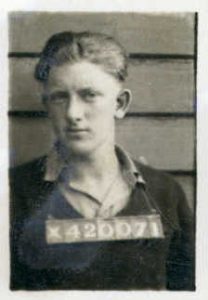
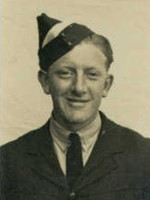
Des and Ian decided to fly the shortest way back to England. Using a route over Ostfriesland, they flew north of Emden over the Groningen coast. They had lost a lot of altitude by then: of the 12,000 feet (about 4 km) when they caught sight of the German plane, only 6,000 feet (about 2 km) was left. At 9 p.m. they sent out a distress signal.
An hour after the first engine failed, the usually so reliable second engine on the left side also began to sputter and vibrate very badly. The plane, because it was flying so low, was hit by anti-aircraft fire from the ground. Des asked Ian to jump out. At first Ian couldn’t get the door open, but eventually he did and reached the ground safely at Overschild. On landing, he sprained his ankle and then quickly hid his parachute. He heard the plane crash and saw flames. Ian was helped by a farmer, but unfortunately he was also seen by others and captured by the Germans. Flying Officer Ian Fowler spent the rest of the war in German captivity.
Meanwhile, the plane was descending further and further, and eventually Des too managed to leave the plane through the cramped door. But the plane had already dropped too low, below 600 feet (about 200 m), so his parachute failed to open before he hit the ground. Desmon must have died, age 20 instantly, age . The Mosquito crashed at 9:48 p.m., less than four hours after taking off from England, near Drewerderhof farm, between Garrelsweer and Winneweer.
It was the RAF’s first Mosquito with special radar to be lost. The four other aircraft taking part in the operation had already landed at their bases by 9:30 p.m. The Germans viewed the wreckage of the aircraft and especially the radar with great interest, and then cleaned everything up. The farmer of the neighboring farm took the tail wheel of the plane, which served as a wheel for a manure wheelbarrow until the end of 1968. In 1970, Des’ family received this wheel as a tangible reminder.
According to Article 17 of the Geneva Convention, the remains of opponents should be treated honorably. Therefore, on Saturday, 26-02-1944, Desmon’s remains were buried with military honors by the Germans in the general cemetery in Loppersum. The Germans first showed Ian Fowler the remains of his colleague Des and, according to Ian, the parachute had indeed not opened. One of the witnesses to the burial was Fokko Bloema of Wirdumerweg. He was pruning orcutting down a number of trees in the cemetery that day. A simple wooden cross was placed on the grave. Only a few years after the war this cross was replaced by the white stone that now stands on it. It was also then that the familiar green Commonwealth Wargraves Commission sign came to hang on the cemetery fence.
Ian Fowler  survived his captivity in German (later Polish) Silesia, among other places. At the end of the war, he experienced a death march
 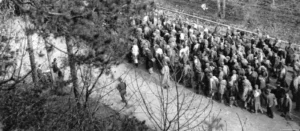 with much hunger and cold from East Germany to Tarmstedt near Bremen. In 1995 he visited Garrelsweer and Loppersum to visit the grave of his colleague. Ian died in Calgary on 04-08-2014, at the age of 93. The same place where Desmon had begun his Canadian advanced training in 1942.



Leave a Reply