

Sherman, Forrest Purcival, born 30-10-1896 in Merrimack, New Hampshire,  to Frank James Sherman ( 1874-1945) and his wife Grace Gibbs, born Allen, Sherman (1877-1948). Forrest had three brothers: Frank James Jr. (1902-1978), Paul Dwight Sherman ( 1908-1987) and Ernest Lincoln Sherman ( 1910-1988). Forrest was a member of the Naval Academy
  class of 1918, graduating in June, 1917 due to America’s entry into World War I. During and shortly after World War I, he served in European waters as an officer of the gunboat Nashville and destroyer Murray. In 1919–21, Sherman was assigned to the battleship Utah and destroyers Reid and Barry, serving as Commanding Officer of the latter. Following duty as Flag Lieutenant to Commander Control Force, Atlantic Fleet, he received flight training at NAS Pensacola, Florida.
  Designated a Naval Aviator in December 1922, Lieutenant Sherman was assigned to Fighting Squadron 2 until 1924, when he returned to Pensacola as an instructor. Study at the Naval War College was followed in 1927 by service in the aircraft carriers Lexington and USS Saratoga
  . While in the latter ship, he commanded and was Flag Secretary to Commander Aircraft Squadrons, Battle Fleet. Promoted to the ranks of Lieutenant Commander in 1930 and Commander in 1937, during that decade Sherman served at the Naval Academy, commanded Fighting Squadron 1,
  had charge of the Aviation Ordnance Section of the Bureau of Ordnance, was Navigator of the aircraft carrier Ranger and had duty on a number of flag staffs. In 1941–42, he served with the Office of the Chief of Naval Operations and was a member of the Permanent Joint Board on Defense, Canada-United States. Captain Forrest Sherman worked closely with then US Army Major Albert C. Wedemeyer
to Frank James Sherman ( 1874-1945) and his wife Grace Gibbs, born Allen, Sherman (1877-1948). Forrest had three brothers: Frank James Jr. (1902-1978), Paul Dwight Sherman ( 1908-1987) and Ernest Lincoln Sherman ( 1910-1988). Forrest was a member of the Naval Academy Designated a Naval Aviator in December 1922, Lieutenant Sherman was assigned to Fighting Squadron 2 until 1924, when he returned to Pensacola as an instructor. Study at the Naval War College was followed in 1927 by service in the aircraft carriers Lexington and USS Saratoga . While in the latter ship, he commanded and was Flag Secretary to Commander Aircraft Squadrons, Battle Fleet. Promoted to the ranks of Lieutenant Commander in 1930 and Commander in 1937, during that decade Sherman served at the Naval Academy, commanded Fighting Squadron 1, had charge of the Aviation Ordnance Section of the Bureau of Ordnance, was Navigator of the aircraft carrier Ranger and had duty on a number of flag staffs. In 1941–42, he served with the Office of the Chief of Naval Operations and was a member of the Permanent Joint Board on Defense, Canada-United States. Captain Forrest Sherman worked closely with then US Army Major Albert C. Wedemeyer
 author of the “Victory Plan of 1941”, “the blueprint..” “..for the mobilization of the United States Army for World War 2”. Wedemeyer, while working in the War Plans Department, was commissioned to write the “Victory Plan by General Georg Catlett Marshall.
 “The Victory Plan predicted the future organization for an army that did not yet exist, outlined combat missions for a war not yet declared, and computed war production requirements for industries that were still committed to peacetime manufacture.” Captain Forrest Sherman’s personal relationship with Major Albert Wedemeyer “ensured a community of planning effort between the two services and pointed to a future in which the services would acknowledge that mobilization planning was a joint responsibility that one service alone could not conduct adequately.” In May 1942, after reaching the rank of Captain, Sherman took command of the carrier Wasp, taking her through the first month of the Solomon Islands campaign. After Wasp was sunk by a Japanese submarine
  on 15-09-1942, he was awarded the Navy Cross for his extraordinary heroism in command of the carrier during the opening days of the South Pacific operations. Sherman then became Chief of Staff to Commander Air Force, Pacific Fleet
  . In November 1943 Rear Admiral Sherman was assigned as Deputy Chief of Staff to the Pacific Fleet commander, Admiral Chester William Nimitz.
 He held that position for the remainder of World War II, playing a critical role in planning the offensives that brought victory in the Pacific, and was present when Japan surrendered on 02-09-1945.

Following a short tour as a carrier division commander, in December 1945 Vice Admiral Sherman became Deputy Chief of Naval Operations. Sherman’s next assignment, beginning in January 1948, was to command the Navy’s operating forces in the Mediterranean Sea. He was recalled to Washington D.C, at the end of October 1949 to become Chief of Naval Operations, with the rank of Admiral. During the next sixteen months, he helped the Navy recover from a period of intense political controversy, as in the so-called “Revolt of the Admirals” and oversaw its responses to the twin challenges of a hot war in Korea and an intensifying cold war elsewhere in the world.
Death and burial ground of Sherman, Forrest Purcival.


On 22-07-1951, while on a military and diplomatic trip to Europe, Admiral Forrest Sherman died in Napels, Italy, following a sudden series of heart attacks, aqe 54, on 22-07-1951. Sherman is buried with his wife Dolores, born Bronson, who died at the very old age of 103, in 2005, on Arlington National Cemetery, Section 30. Close by the graves of Admiral Robert Ghormley, Lieutenant General, Commanded the 5th Marine Division, nickname ” The speargead Fighting Fifth”  , in the occupation of Japan, Thomas Bourke. The 5th Marine Division casualties during the battles; killed in action/died of wounds/missing in action – 2.501, wounded in action – 5.948, total casualties– 8.363.
, in the occupation of Japan, Thomas Bourke. The 5th Marine Division casualties during the battles; killed in action/died of wounds/missing in action – 2.501, wounded in action – 5.948, total casualties– 8.363.Lieutenant General, Commander 2nd Armoured Division, Ted Brooks, Major General, Chief Signal Officer, George Back, Infantry Major General. Commander 24th Infantry Division  The casualties of the 24th Division; total battle casualties: 7.012, killed in action: 1.374, wounded in action: 5.621, missing in action: 11, prisoner of war: 6, Kenneth Cramer, Infantry Major General. Commander 9th Infantry Division, Louis Craig, Air Force Lieutenant General, Commander 12th and 15th U.S. Air Force, Ira Eaker, Navy Admiral, Okinawa Campain,
The casualties of the 24th Division; total battle casualties: 7.012, killed in action: 1.374, wounded in action: 5.621, missing in action: 11, prisoner of war: 6, Kenneth Cramer, Infantry Major General. Commander 9th Infantry Division, Louis Craig, Air Force Lieutenant General, Commander 12th and 15th U.S. Air Force, Ira Eaker, Navy Admiral, Okinawa Campain, The Battle of Okinawa, codenamed Operation Iceberg,  was a battle of the Pacific War fought on the island of Okinawa by United States Army and United States Marine Corps forces against the Imperial Japanese Army. The initial invasion of Okinawa on 01-04-1945 was the largest amphibious assault in the Pacific Theater of World War II. The Kerama Islands surrounding Okinawa were preemptively captured on 26 March by the 77th Infantry Division, nicknamed the “Statue of Liberty Division“;
  under command of Major General Andrew Davis Bruce,
was a battle of the Pacific War fought on the island of Okinawa by United States Army and United States Marine Corps forces against the Imperial Japanese Army. The initial invasion of Okinawa on 01-04-1945 was the largest amphibious assault in the Pacific Theater of World War II. The Kerama Islands surrounding Okinawa were preemptively captured on 26 March by the 77th Infantry Division, nicknamed the “Statue of Liberty Division“; under command of Major General Andrew Davis Bruce,
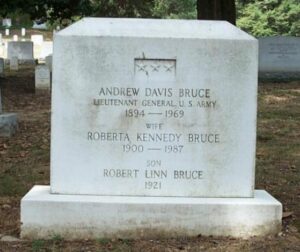 Bruce survived the war and died 01-07-1969 (age 74) in Moore County, North Carolina, USA.
The 82-day battle lasted from 1 April until 22 June 1945. After a long campaign of island hopping, the Allies were planning to use Kadena Air Base on the large island of Okinawa as a base for Operation Downfall, the planned invasion of the Japanese home islands, 340 mi (550 km) away. ircraft losses over the three-month period were 768 US planes, including those bombing the Kyushu airfields launching kamikazes. Combat losses were 458, and the other 310 were operational accidents. At sea, 368 Allied ships—including 120 amphibious craft—were damaged while another 36—including 15 amphibious ships and 12 destroyers—were sunk during the Okinawa campaign. The US Navy’s dead exceeded its wounded, with 4,907 killed and 4,874 wounded, primarily from kamikaze attacks.
It was in this operation that Ernest Taylor “Ernie” Pyle  was killed. Ernie was an American journalist who was one of the most famous war correspondents of World War II.
was killed. Ernie was an American journalist who was one of the most famous war correspondents of World War II.Ernie beloved by his co-workers, GIs and Generals alike, was killed by a Japanese machine-gun bullet through his left temple on 18-04-1945, age 44.
Also buried in Section 30, Admiral,Louis Emil Denfeld, Secretary of the Navy in 1944, James Forrestal

 and General, Deputy Chief of Staff, Bomb on Hiroshima, Thomas Handy and 1* General Lieutenant, Commanding Officer Artillery, 11th Airborne Division
  . nicknamed “Angels” Francis William Farrell. Casualties of the 11th Airborne Division, during their 204 days in combat in the Pacific, were 2.300.
– –
– *
*
–*


Leave a Reply