

Rost van Tonningen, Meinoud Marinus, born 19-02-1894 in Soerabaja, what was then the Dutch East Indies (now Indonesia). Meinoud was the youngest son of KNIL, Koninklijk Nederlandsch-Indisch Leger/ Royal Netherlands East Indies Army, General Marinus Bernardus Rost van Tonningen,  who had distinguished himself in battles on Lombok, Aceh, and Bali, among other places. Marinus Rost van Tonningen died in 1927 at the age of 74. He was cremated at the Velsen crematorium. Meinoud’s mother was Jonkvrouw Menauda Sara Johanna van den Bosch. After attending the Hogerburgerschool (higher civic school) in The Hague, he initially began an engineering program in Delft before studying law in Leiden, where he later obtained his doctorate. He was a keen sportsman and, in addition to fencing, he rowed for D.S.R.V. Laga (The Delft Student Rowing Club ‘Laga’)
  and later for KSRV Njord.
  He won the Varsity for Laga, a rowing competition for students in the Netherlands on the Amsterdam-Rhine Canal near Houten.. His eldest brother, Vice Admiral Nicolaas “Nico” Albertus Rost van Tonningen,
  was, among other things, Grand Master to Queen Juliana, and his middle brother, Wim Rost van Tonningen, was Chief Engineer at the Batavian Petroleum Company BPM.
From 1923 to 1928 and from 1931 to 1936, he was the League of Nations  representative in Vienna, initially in a subordinate position and later in a leading role, to supervise Austrian financial policy. He initially worked under the former mayor of Rotterdam, Alfred Rudolph Zimmerman,
  and from 1931 to 1936 independently as a League of Nations representative. When he first left Vienna, Rost van Tonningen was awarded the Große Ehrenzeichen für Verdienste (Grand Decoration of Honor for Services).
 From 1928 to 1931, Rost van Tonningen lived with his then first wife Mary Sara Gordon Hasselbach, in Amsterdam. In Austria after 1931, he developed increasingly strong anti-Semitic and anti-Communist views. In Austria, he was initially also good friends with Chancellor Engelbert Dollfuss,
 who was assassinated in 1934, with whom he strongly disagreed on whether Austria should join Germany; Rost van Tonningen saw no point in prohibiting the so-called Anschluss, the annexation of Austria to the German Reich.
In 1934, his ideas underwent a radical change: from a moderate corporatist, admirer of the anti-Nazi autocrat Dollfuss, and respected member of the Corps Diplomatique, he became a radical National Socialist of the type found in the banned, underground Austrian SS. As a result, he refused to cooperate with Austrian Chancellor Kurt Alois Josef Johann (Edler von) Schuschnigg 
 from 1934 to 1936; Rost sought to join von Papen, Franz Joseph Hermann Michael Maria von “Fränzchen”,
  a German diplomat. His second wife, Rost van Tonningen-Heubel, Florence Sophie “Florrie”
 would remain friends with him even after the war. Florie was the sister of Willem Johannes “Wim” Heubel

 , a Dutch national socialist activist, NSB and as a SS Hauptsturmfuhrer commanding the 5th company of the 83rd SS Regiment of the 34th SS Volunteers.
  Grenadier-Division “Landstorm Nederland”.
After Rost van Tonningen returned from Austria in 1936, he divorced his first wife, Mary Sara Gordon Hasselbach, whom he had married in 1924. Two daughters were born during Rost van Tonningen’s first marriage, Nicolette en Hildegard. On the same day, August 07-08-1936, he became a member of the NSB 
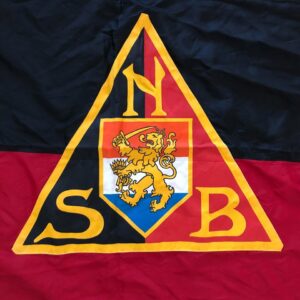 . NSB stands for the National Socialist Movement, a Dutch fascist political party founded in 1931 by Anton Adriaan, “Ad” Mussert.


 He won a seat in parliament in the elections.
He also became editor-in-chief of Het Nationale Dagblad, the NSB’s party newspaper, which he turned into a mouthpiece for his own ideas (much to the chagrin of some of the NSB leadership). Rost van Tonningen was a National Socialist who was mainly oriented towards Germany and the ‘Greater German idea’, while Anton Mussert had more affinity with Mussolini, Benito Amilcare Andrea “Il Duce” 

It was mainly Rost van Tonningen’s influence that caused the NSB to become more openly anti-semitic; Rost van Tonningen’s anti-semitism was more radical than NSB leader Anton Mussert. Because of his influence, the NSB became closer to the German Nazi Party, the NSDAP. 
1939 saw Rost van Tonningen establish the paramilitary organisation – the Mussert guards. Many members of this organisation later became members of the Nederlandsche SS. Rost van Tonningen’s request to be admitted as a member of the SS Westland regiment was at first denied, because he had been born in the Dutch East Indies, and was unable to obtain documents showing that his family had 150 years of “pure Aryan blood”. However, from 1943, Indos (Dutch Eurasians) could join the lower ranks of the Waffen SS. (Whereas those deemed to be “Native Indonesians”, with no or little European ancestry, were still not allowed.) In 1944, Rost van Tonningen again applied for membership of the SS, and was admitted.
During the German occupation of the Netherlands, Rost van Tonningen was appointed liquidation commissar for all Marxist organisations by Arthur Seyss-Inquart, the Austrian administrator for the Netherlands.
This was targeted especially at the Social Democratic Workers’ Party (SDAP),  the Revolutionary Socialist Party (RSAP),
  and the Communist Party (CPN).
  The CPN and RSAP had to be liquidated, while the SDAP had to be “reconstructed” based on Nazi doctrine. This reconstruction failed because the SDAP had destroyed most of its archives and administration papers.
The SDAP leadership leaders included Henri Polak (first chairman),  Pieter Jelles Troelstra,
  and Jacobus Jan (Koos) Vorrink
  (last chairman) refused to cooperate, and during regional meetings of the SDAP it was announced that the SDAP would not collaborate with the German occupation forces. Virtually all SDAP affiliated organisations refused to cooperate with Rost van Tonningen’s attempts to ‘Nazify’ them. Most organisations (e.g., Labourers Sports Association, musical organisations) chose to dissolve themselves rather than become part of the Nazi hierarchy. On 05-07-1941, the SDAP was disbanded, together with all other remaining political parties.
On 26-03-1941, Rost van Tonningen was appointed to the posts of Secretary-General of the Finance ministry and President of the Dutch Central Bank, the Nederlandsche Bank. During his tenure in these functions, the Germans held the Netherlands financially responsible for the costs of the occupation of their country. The total cost of this to the Dutch society was calculated by the Dutch government after the war as being 9,488,000,000 Reichsmark. Besides this amount, an amount of 5,750,000,000 Reichsmark of loans made by the Netherlands to Germany was never repaid, so a total amount of 14,500,000,000 Reichsmark flowed to Germany. (Comparison: France 43,250,000,000 and Belgium 11,070,000,000.)
As Secretary-General for Special Economic Affairs, Rost van Tonningen was involved in the establishment of the Nederlandse Oostcompagnie (Dutch East Company), an organisation involved in the reconstruction of Ukraine. The efforts of this company were an abysmal failure.
Death and burial ground of Rost van Tonningen, Meinoud Marinus.


On 05-09-1944, Dolle Dinsdag (Mad Tuesday), Rost van Tonningen fled with a number of other Dutch collaborators, fearing the rapidly advancing Allied armies. He turned up again a few days later, but was fired from his position as successor to the NSB leadership by Anton Mussert after writing an article in which he praised the members of the Dutch NSB youth organisation (Nationale Jeugdstorm, National Youth Storm) who had joined the Hitlerjugend division. 
In the summer of 1944, Rost van Tonningen was trained to be an officer in the first battalion of the Landstorm Nederland, a Dutch paramilitary defense organisation. In March 1945 he left for the frontlines, which ran through the middle of the Netherlands, in the Betuwe. On 08-05-1945 he was taken prisoner by Canadian troops, and was held in a prisoner camp in Elst. From there he was transferred to Utrecht and on 24-05-1945 he was moved to the prison in Scheveningen.

 Rost van Tonningen allegedly committed suicide there by jumping from a balcony in the prison on 06-06-1945, age 51. Florrie Heubel has always denied that her husband committed suicide; she believes he was murdered. The motive was allegedly that, as president of De Nederlandsche Bank (the Dutch Central Bank), her husband knew too much about the undeclared money transactions of prominent figures.
His second wife, Florentine Rost van Tonningen, continued to promote pro-German and Nazi views after the war, denying the Holocaust and regretting the fall of the Third Reich and any threat to racial purity. One of their sons, Ebbe Rost van Tonningen,  published a memoir in 2012 about his childhood, In Niemandsland (“In No Man’s Land”).
Meinoud Marinus Rost van Tonningen was buried in a mass grave along with Anton Mussert NSB leader, Robert van Genechten,  A Flemish-Dutch jurist, economist, author, and administrator. He collaborated with the German occupiers of Belgium and the Netherlands during both the First and Second World Wars. “He betrayed two fatherlands.” and Marius Hugh Louis Wilhelm (Max) Blokzijl
  , a Dutch singer and journalist. During World War II, Blokzijl was one of the Netherlands’ most famous radio presenters and head of the Press Office.. In the mid-1950s, Florrie attempted to have her husband interred in the family grave. This was refused because, reportedly, they could no longer identify the bones. Later, the bones of Meinoud and Mussert, among others, ended up in a bone pit.


Leave a Reply