

Popping, Hendrik Jan, born 23-04-1885 in Oosterwolde 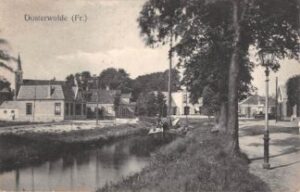 in Friesland initially worked as a reporter for various local and regional newspapers, but made a name for himself as a local historical expert and advocate for the Stellingwerfse language, a Low Saxon dialect that has long existed alongside Frisian. From an early age, his father instilled in him a love of archaeology, and more besides. When Popping Sr. died in 1927, he left his son a printing business with an adjoining book, paper, and music shop, a publishing house, an advertising agency, and the regional newspaper De Ooststellingwerver.
 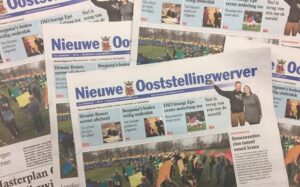 This provided him with an income to continue his archaeological activities and also a platform for publication. Despite his lack of formal education, Popping proved to be well-developed. In terms of content, he held his own among his professional colleagues in the field of archaeology. However, he was easily offended and often severed old and valuable contacts, such as with Albert Egges van Giffen,
 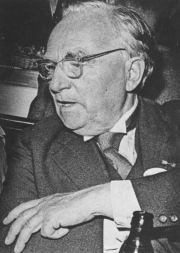 who can be considered the father of modern archaeology in the Netherlands. In his political statements, Popping also regularly used toxic language, propagating his own ideas as the only correct ones. In 1944, Popping called Queen Wilhelmina

 “a fallen majesty, a pitifully screeching, bile-filled old hag.” A statement that would not remain without consequences.
In 1935, the Fries Genootschap acquired a large part of his collection when Popping needed money for a new car. The associated intention to appoint Popping as curator of the newly established department ‘oldest culture of Friesland’s sand and peat regions’ failed due to Popping’s financial demands. In 1940, the remaining part of his collection was acquired by the BAI, although Popping had initially offered it to the National Museum of Antiquities. By then, Popping was no longer doing much practical research, but he published all the more about the archaeology of his native region.
Gradually, Popping’s political views became more radical, which was reflected, among other things, in the openly anti-Semitic Stoarm en Striid, the regional NSB  newspaper for Friesland, of which he became editor-in-chief in 1936.
NSB stands for the National Socialist Movement, a Dutch fascist political party founded in 1931 by Anton Mussert. 


Disappointed when he was not appointed provincial party leader in 1939, Popping resigned as a member of the Provincial Council and withdrew his membership of the NSB, which he had already accused of being too moderate. Nevertheless, he rejoined the party in 1940, only to be expelled shortly afterwards after criticising the party leadership in an article. In 1943, Popping became a supporting member of the Germanic SS in the Netherlands. 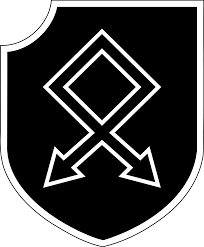 These members were not dormant members in the role of donors. They were expected to actively spread SS
  ideology by, among other things, selling the magazine Storm-SS
 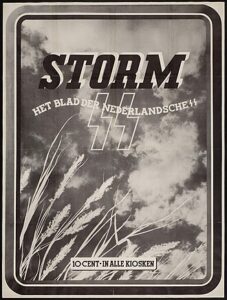 door-to-door. It is unknown whether Popping also went door-to-door, but he probably sold the magazine through his shop. In addition, members had to take the oath of allegiance to Adolf Hitler of the Dutch SS, which still existed in 1942. And great moral pressure was exerted on members to enlist in the Waffen-SS.
  Popping’s membership can perhaps be explained by his disappointment in the NSB. The Germanic SS was led by Voorman Johannes Hendrik “Henk” Feldmeijer,
 who, unlike Mussert, sought to merge the Netherlands into a Greater Germanic Reich. Popping may have found more affinity with Feldmeijer’s ideas than with those of Mussert.
Although his aversion to Judaism and glorification of Germanic thot had already seeped into his letters and archeological work before the war, this was particularly evident during the war years in his articles in De Ooststellingwerver, which he still owned himself. When the weekly newspaper was threatened with closure in 1942, he argued in a letter to the wife of the Dutch NSB leader, Rost van Tonningen.
 She “ The Black Widow “ remained an extreme Nazi till the end. Rost van Tonningen-Heubel, Florence Sophie “Florrie”
  that the publication ‘propagated the Greater Germanic idea and National Socialism’. A remark that was held heavily against him during his later trial. Popping also claimed to be on familiar terms with the German authorities. His house was also a gathering point for the local Dutch Landwacht,
 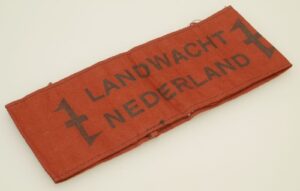 partly due to the presence of a telephone.
When the weekly newspaper was threatened with closure in 1942, he argued in a letter to M. Rost van Tonningen that the publication ‘propagated the Greater Germanic idea and National Socialism’. A remark that was held heavily against him during his later trial. Popping also claimed to be on familiar terms with the German authorities. His house was also a gathering point for the local Landwacht, partly due to the presence of a telephone.
Popping was arrested and interned in April 1945. In January 1948, he appeared before the Special Court in Leeuwarden. The charges were for treason and making propaganda for the German cause. He was also accused of collaborating with the enemy in practice. He is said to have betrayed an arms drop in September 1944 and pointed out the hiding place of two local tax officials involved in resistance activities to the Germans in February 1945. Both had tragically died in a concentration camp in Ludwigslust, Germany, in the final days of the war. The prosecutor demanded a ten-year prison sentence, a lifetime ban from active and passive suffrage, and a prohibition on any journalistic activity. In the verdict, this was reduced by a year to nine years with deductions, and Popping was no longer allowed to work in the publishing business.
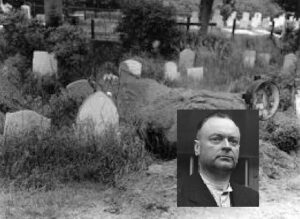
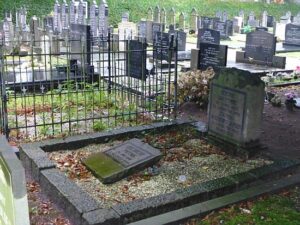
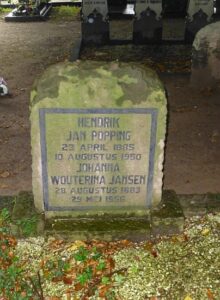
Death and burial ground of Popping, Hendrik Jan.

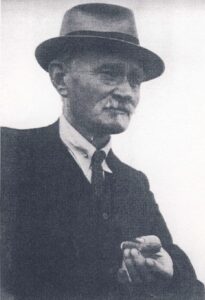
During his imprisonment, Popping continued to write, particularly in the form of historical novels about the early history of his native region. As early as 1915, he had ventured into the realm of the novel with Free Frisians. A story from the early years after the Christian era. And during the war years, Popping published Markward Portenga 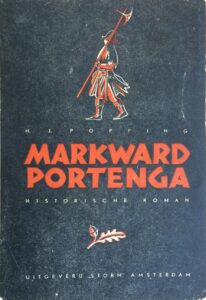 in 1942. The book was set in prehistoric times. In 1950, Popping was released, likely for health reasons. His family had previously submitted a request for clemency because Popping was suffering from leukemia. On June 26th, he returned to Oosterwolde, where he died on 10-08-1950, age 65. Hendrik Jan Popping was buried in the Oosterwolde cemetery, next to his parents’ grave. In 1956, his wife Johanna Wouterina Jansen, whom he had married in 1909, passed away. The couple had one daughter, Elisabeth, born in 1911, who was also buried in her parents’ grave after her death in 1996.
Message(s), tips or interesting graves for the webmaster: robhopmans@outlook.com


Leave a Reply