

Koot, Hendrik Evert, born 05-04-1898, Amsterdam, Netherland and raised in Amsterdam. Koot joined the National Socialist Movement in the Netherlands (NSB) 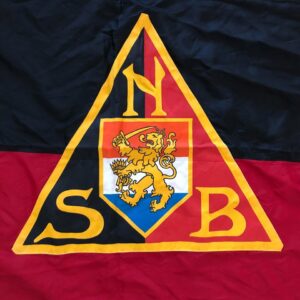 of Anton Adrian “Ad” Mussert,


 in 1935, with his wife, Elisabeth van Groningen, the latter being apparently influenced by a speech by the NSB founder, at the Concertgebouw. At some point, he worked for Asscher, a Jewish diamond cutter. They had eight children; the eldest two had gone to sea to join the merchant navy, but all of the others joined various Nazi
  and fascist organizations. Two joined the SS
  , one the Dutch Landstorm
  and another the Nationale Jeugdstorm
  (the Dutch version of the Hitler Youth
  ) . One of Koot’s sisters had married a German soldier, and another married a Dutch SS volunteer. After Koot’s death, his wife married another WA man.
The Koot family had a winning lottery ticket in 1932 and, combined with savings, that allowed them to buy a store that sold equipment and supplies for textile manufactures to which moved on the Vijzelstraat (no. 88)  in 1938 and renamed Hako, for “H. Koot”.
Koot moved up in the NSB ranks as well and quickly rose to the rank of sergeant. During the 1941 events, he had attained the rank of opperwachtmeester, the highest rank for a non-commissioned officer.
By January 1941, far-reaching measures to restrict Jews had been enacted, and SS Obergruppenführer Rauter, Johan Baptist Albin “Hanns”, 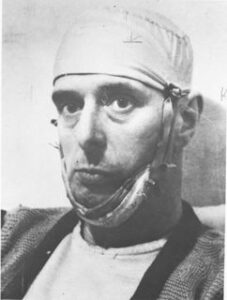
 the Austrian-born SS and Police Leader in the Netherlands, had ordered thugs to collaborate with the Nazis in beating up Jews and creating civil unrest in the hope to provoke Jewish resistance.
At the same time, though, Hans Böhmcker, 
 the representative in Amsterdam for Arthur Seyss-Inquart,

 Reichskommissar for the Netherlands, had forbidden WA members from entering Jewish neighbourhoods.
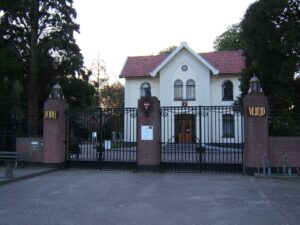
Death and burial ground of Koot, Hendrik Evert.

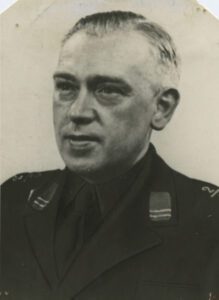

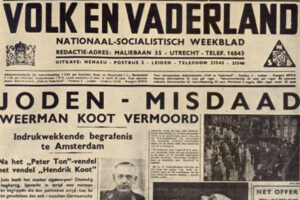
Koot in fact entered such a neighborhood, with some 40 other WA members (one of his sons was also there and was also wounded). 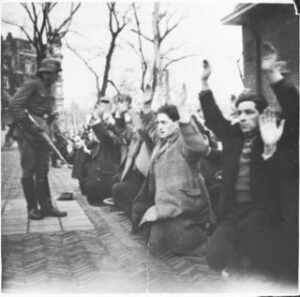 He got beaten up by a Jewish knokploeg (“action group”) on 11-02-1941, on the Waterlooplein. His injuries were so severe that he died a few days later age 42 on 14-02-1941 After Koot’s death, Rauter himself wrote an op-ed in the NSB paper Volk en Vaderland
 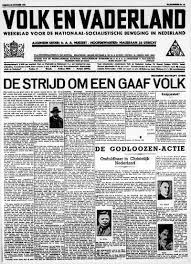 that salaciously described the act: “a Jew had ripped open the victim’s artery with his teeth and sucked his blood out”, in “an obvious allusion to ritual murder”. According to the Dutch historian Jacques Presser, in the lurid descriptions of the murder, the Nazis betrayed “their own bestiality rather than describe the actual facts”. Those lurid details are not confirmed in the police reports, which had gotten lost but were found again, and are available through the Amsterdam City Archives.
Het Parool, the resistance paper, reported on 25 February that Koot had died after enduring one single wound, a blow to the head by a heavy object such as an axe or a club, which is mentioned in the police report of 18-02-1941. 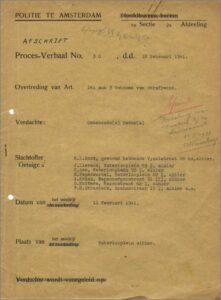 Koot’s funeral took place on 17 February,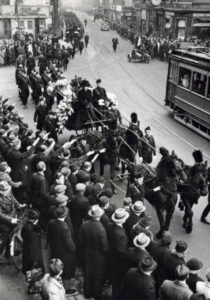
 at Zorgvlied cemetery. A funeral procession, complete with marching band, preceded his horse-drawn carriage, two thousand Nazis with flags marched through town and Wolfsangels were affixed to the grave.
Response was immediate. The Jewish neighborhood was sealed off by German authorities, which effectively began the Amsterdam ghetto, and a Judenrat was put into place.  The Nazis established a Jewish Council (Judenrat), the Jewish Council for Amsterdam, which was responsible for carrying out their orders, such as organizing deportations.
Protests broke out, and the raid on an ice cream parlor, a known hangout for a Jewish knokploeg, saw German police forces being attacked in retaliation and possibly sprayed with acid. The Germans decided to round up a large number of Jewish men, which gave the local communist resistance groups an opportunity to agitate the population enough to start a strike.

The German occupiers saw the unrest surrounding the riots and Koot’s death as sufficient reason to carry out the first large-scale raids on the Jewish population, including on Jonas Daniël Meijerplein, on February 22 and 23, 1941.  These two raids, in turn, were the catalyst for the February strike. On 15-02-1942, the Amsterdam WA commemorated his death with great pomp and circumstance. A newspaper report stated that “the WA is marching” and “a solemn commemoration will take place at Zorgvlied, at which the acting commander of the WA, Oberherbanleiter H.C. van ‘t Hof, will speak.”Koot had a wife and eight children, six of whom were active in the fascist movement.
  His widow, Elisabeth Koot-Van Groningen, was assigned three Jewish clothing stores, which had been confiscated by the occupiers, to support her family. She was tried for this on 23-01-1947, and two weeks later was sentenced to two years in prison.
Koot, Hendrik Evert is buried at the Cemetery of ‘Zorgvlied’ in Amsterdam South. Amsteldijk 273, 1079 LL Amsterdam.



Leave a Reply