

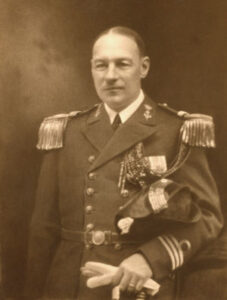
Doorman, Karel Willem Frederik Marie, born 23-04-1889 in Utrecht,  Utrecht Municipality, Utrecht, Netherlands, to Carel Willem Fredrik Doorman, 1st Lieutenant Quartermaster, 36 years old, living in Utrecht Oostertolsteegsingel 31 and his wife Anna Catharina Theresia Maria, born Kleijntjens. They had two sons and one daughter, Karel Willem Frederik Marie (09-11-1924, Batavia), Anna Justine Maria (11-08-1926, The Hague) and Simon Joseph (07-12-1928, The Hague). They divorce and on 16-06-1934, the divorce between Karel Doorman and Justine Schermer was made official. Doorman had two sisters and two brothers. Ludovicus Antonius Carel Maria Doorman, Henrika Theresia Johanna Maria Doorman and Jan Willem Robert Henri Doorman.
Doorman remarried on 08-10-1934, in The Hague as “Captain-Lieutenant at Sea” to Isabelle Jacqueline Julie Jeanne Heijligers, a young woman living in The Hague, aged 23, born in Rotterdam, but whose parents, Adriaan Theodoor Louis Allard Heijlingers, a judge, aged 52, and Maria Helena Pool, aged 57, lived in Alexandria, Egypt. From this marriage, a son was born, named Theo. After Karel’s death, he and his mother moved to Australia.
Growing up in a family of professional soldiers, having in his family branches ancestors, who held high military posts, like only in his direct lineage, thirteen generals, it was very natural that Karel would pursue a career in the defense of the country.
After primary school Karel attended the Hogere Burgerschool at the Keizersgracht in Amsterdam, situated in the Coymanshuis, at the Keizersgracht in Amsterdam.  In 1909 Doorman was drafted into military duty. He was exempted because he was already in military training at the K.I.M. in Den Helder Noord-Holland, The Netherlands, as midshipsman since 1906. Doorman was made an officer in 1910. He sailed with the Tromp to the Dutch East Indies. During his first tree years of duty he was mainly tasked with mapping the coasts of New Guinea on other ships. At his return in 1914, as he got interested in airplanes, he asked for a transfer to the Aviation Service in Soesterberg.
In 1915 the transfer was approved. Karel received his civil flying license in October 1915 and in 1916 his naval flying wings. Doorman became one of the first naval officers with pilot wings. He met in those years Albert Plesman.
Karel suffered a nasty and serious arm injury in 1919 when he fell into a hole while skating, a condition that plagued him for the rest of his life. This, along with budget cuts at the Naval Air Service, forced Doorman, who fiercely opposed the cuts and saw a new war looming, to abandon his flying career, and was willing to do so. From 1921 to 1923, he returned to school and trained at the Higher Naval War School in The Hague 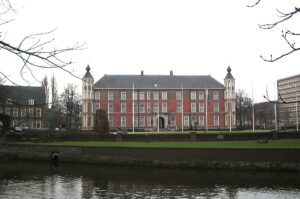 to further his advancement in staff positions.In 1923, after successfully completing his training, he was ordered to ensure effective cooperation between the Dutch Naval Air Force and the Royal Netherlands East Indies Army (KNIL)
  aviation department. Unfortunately, this never materialized.In 1926, Doorman was again assigned to a long-term ship, the HNLMS De Zeven Provinciën. The HNLMS De Zeven Provinciën
  was the last and largest armored ship built for the Dutch Navy at the Rijkswerf in Amsterdam. The ship was the sixth Dutch naval vessel to bear the name Zeven Provinciën. The ships were named after the Zeven Provinciën, which were the predecessors of the Republic of the Seven United Netherlands.
Doorman traveled to Batavia three times. Meanwhile, as a Captain at Sea in 1937, Doorman commanded the cruisers Sumatra and Java. 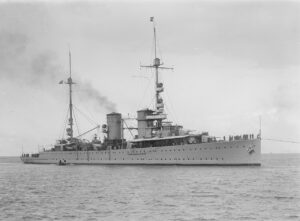 In 1938, he was appointed Commander of the Naval Air Service in the Dutch East Indies.
In May 1940, Doorman was appointed Rear Admiral and a month later was given command of HNLMS de Ruyter. In early 1942, he commanded the Combined Striking Force of the American-British-Dutch Australian Command (ABDACOM). Before the battle on the Java Sea, Doorman spoke by telephone with Lieutenant Admiral Conrad Emil Lambert Helfrich,
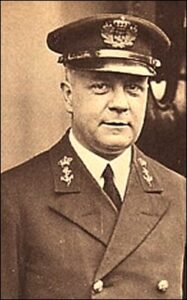
 in which Doorman explained that he considered the chances of an Allied victory very slim and that it would be better for them to assist the Allies outside Java. However, Helfrich stated that withdrawal was unacceptable, and the instructions from Washington were: “hold your ground, including with the fleet.”
Death and burial ground of Doorman, Karel Willem Frederik Marie.


Doorman was forced to confront the Japanese, and although the chance of victory was slim, there was a chance. Doorman went. The attempt by the squadron, consisting of 14 Allied naval vessels, led by Dutch Rear Admiral Karel Doorman, to stop the Japanese invasion fleet ended in failure. Three naval vessels, including a destroyer, were sunk, including the De Ruyter.
Karel Willem Frederik Marie Doorman died on 27-02-1942, at the age of 52, on the Java Sea aboard the HNLMS De Ruyter when the ship was sunk. Doorman’s body was lost in the Java Sea.


Leave a Reply