


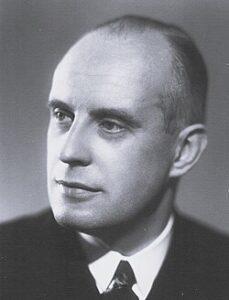
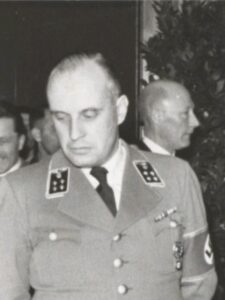
Böhmcker, Hans, born 06-11-1899 in Bad Schwartau, 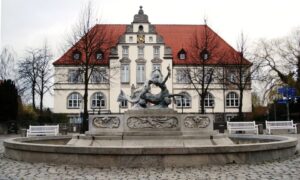 Germany, the son of a lawyer from Bad Schwartau, served in World War I before earning a doctorate in law. He became a judge in Lübeck and joined the NSDAP
  in 1933. That year, he was appointed Senator for Justice, promoting the Nazi policy of Gleichschaltung. As Senate Commissioner for Church Affairs, he restructured the Evangelical Lutheran Church in line with Nazi ideology, installing Erwin Balzer
 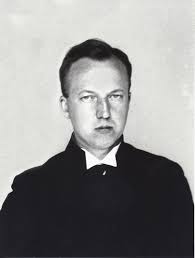 as bishop and suppressing dissent—deploying the Gestapo to silence opposition from the Confessing Church.
Dr. Hans Böhmcker was Beauftrager/Client des Reichskommissars for Amsterdam Arthur Seyss-Inquart,


 from 16-09-1940, to 21-06-1942.
 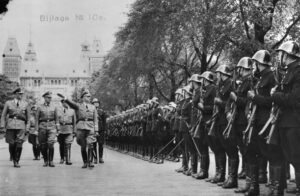 On 18-05-1942, Reichsführer Heinrich Luidpold Himmler


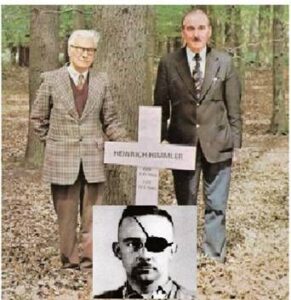 visited Amsterdam. Himmler was the German National Socialist politician and the leader of the SS (Schutzstaffel),
  the German Black Shirts. His visit to the city was mainly focused on preparations for the concentration camps.
Pending his arrival, Kriegsverwaltungsrat Wolfram Rombach 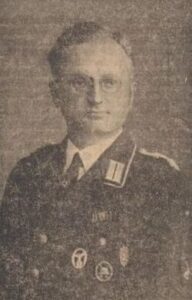 took over his duties from June 25. Böhmcker had joined the NSDAP on 01-05-1933. In 1937, he became mayor of Lübeck. Hans Böhmcker (left)
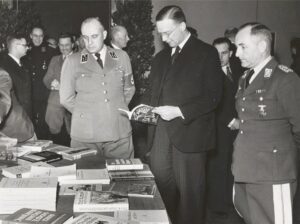
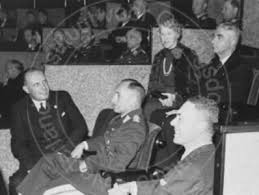
 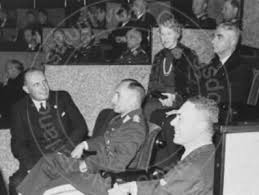 during a screening of the Italian film “Alcazar” at the City Theater in Amsterdam. Next to him, in uniform, is the commander of the Luftwaffe in the Netherlands, Generalleutnant Hans Siburg.
  In the second row is the mayor of Amsterdam, Edward John Voûte,
  with his wife. Edward passed away at the age of 62, 18-06-1950, one year after his release from prison, on 18-06-1950 in Amsterdam,
The persecution of the Jews was seen as a very important task by the anti-Semite and militant National Socialist Dr. Böhmcker. A strong “anti-Semitic movement” had to be established in Amsterdam. Böhmcker was the central figure behind the cordoning off of the Jewish quarter in the early morning of 12-02-1941, at least in the eyes of the Amsterdam municipal authorities and the secretaries-general. The establishment of the Jewish Council also stemmed from Böhmcker’s plans. Formally, as Beauftragte, he should not have been allowed to take such initiatives on his own initiative, as he only had ‘informational powers’. But Böhmcker assumed much more power and authority for himself. In October 1941, Seyss-Inquart appointed Böhmcker as his ‘allgemeiner politischer Vertreter’ (general political representative) for ‘Massnahmen gegen die Judenschaft’ (measures against the Jewish community). The head of the Hauptbüro Verwaltung (main administrative office) at the Beauftragte was Franz Ludwig. 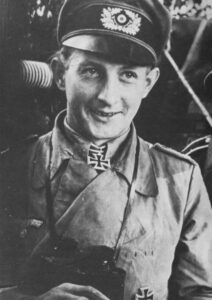
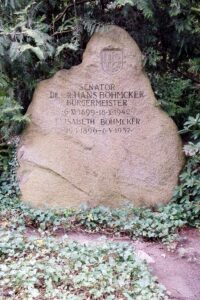
Death and burial ground of Böhmcker, Hans.
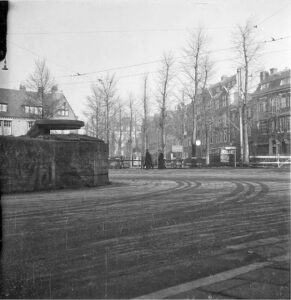
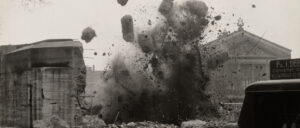
From 1940 to 1942, Böhmcker worked under Reich Commissioner for the Netherlands Seyss-Inquart. Böhmcker acted as representative of the German Reich for the city of Amsterdam. His office was located in the building that now houses the Consulate General of the United States. 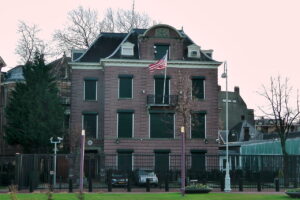 To defend these German institutions, concrete bunkers and barbed wire barriers were erected on Museumplein. This meant that the square became off-limits to ordinary Amsterdammers during the occupation. The second image shows a drawing of Museumplein from 1949. It shows that after the war, the bunkers and remnants of barbed wire were still present. It was not until 1953 that the bunkers on Museumplein were blown up and the square was redesigned. The photo of Museunplein shows a drawing of Museumplein from 1949. It shows that after the war, the bunkers and remnants of barbed wire were still present. It was not until 1953 that the bunkers on Museumplein were blown up and the square was redesigned.

Böhmcker was responsible for implementing all anti-Jewish measures relating to the Jewish question. He also implemented the registration of Jews and, on 12-02-1941, ordered the establishment of the Jewish Council for Amsterdam. On 02-10-1941, Böhmcker wrote to his superior Seyss-Inquart: “Thanks to Regulation 6/41, we now have all Dutch Jews in our pocket.” By September 1941, 140,000 Jews had been registered. However, even before the first structural deportations of Jews in the Netherlands in July 1942, Böhmcker was recalled to become mayor of Lübeck. After a scandal involving corruption—his wife had embezzled funds from the Nazi institution NSV while he was working in the Netherlands—he committed suicide 18-10-1942, age 42, in Lübeck, Germany.
Hans Böhmcker is buried at the Burgtorfriedhof in Lübeck, Stadtkreis/Region Lübeck, Schleswig-Holstein, Eschenburgstraße 20, 23568 Lübeck, Germany.

Message(s) for the webmaster, tips or interesting graves: robhopmans@outlook.com


Leave a Reply