


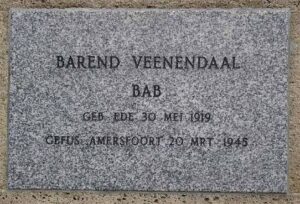
Veenendaal, Barend “Bab” born 30-05-1919 in Ede, 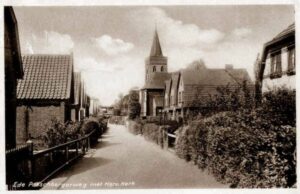 Netherlands, attended the Paasbergschool in Ede. He was an excellent student and was even allowed to skip a grade. Yet he left the school benches early and started working as a house painter in Menno de Nooij’s painting company. In October 1938, he was called up for military service. After the German invasion,
  he was taken prisoner, but returned to his hometown in June 1940, where he resumed work at De Nooij. Around 1943, he was called up for the labor deployment in Germany. In response, he went into hiding for a while in Wehl in the Achterhoek.
The Arbeitseinsatz during World War II meant that young men from occupied areas were forcibly employed in the war economy of Nazi Germany, to replace German men who had been called up as soldiers. Refusal was punishable.
In mid-1943, Veenendaal returned to Ede, where he, along with his brother Elbert, 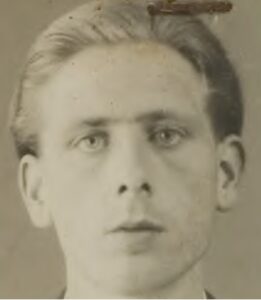
 became involved with the resistance group of De Nooij,
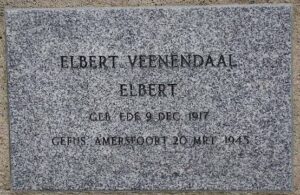
 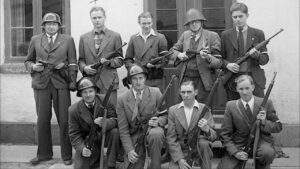 which was part of the National Organization for Assistance to Hiding Persons. They ensured that those in hiding had enough food and ration cards. Additionally, Veenendaal was in contact with Corporal Herikhuizen, who worked at the office of the Ortskommandant. Thru him, he received relevant information for the resistance. Elbert Veenendaal Barend’s brother was born on 09-12-1917. Elbert works for the Dutch Railroads. He also helps with the resistance work. On 17-09-1944, the railroad strike occurs. He then goes into hiding with his wife and child at his family in Ede.
After the Battle of Arnhem, Operation Market Garden  many British Airbornes had no shelter. Elbert was very involved in providing shelter. The work is indeed dangerous for himself and his family. Therefore, his family also does not allow him to do any other resistance work.
On 08-03-1945, he no longer lets himself be held back. He goes along to a weapons drop. There, the Germans capture him and he is taken to the Wormshoef. 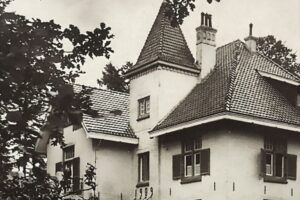 They interrogate and mistreat him there. After that, he ends up in Camp Amersfoort as a Death Candidate. On 20-03-1945, Elbert, age 27, is executed on the Appelweg in Amersfoort.
Shortly after the Allies lost the Battle of Arnhem, the Edese resistance was in contact with the liberated part of the Betuwe. They reported the locations of German positions. On Wednesday, 27-09-1944, Veenendaal warned the residents near the Driesprong on the north side of Ede about an impending English bombing.
On 02-03-1945, both brothers participated in a weapons drop near Lunteren. A few days later, a question was raised from England about whether it was safe to hold another drop at the same location. That was not the case, because after the dropping, the Veenendaal brothers and sixteen others were arrested near the intersection of Goorsteeg and Hessenweg near Lunteren. Henk Veenendaal had insisted to his brothers Elbert and Barend that he should also be allowed to go along, but the brothers had refused. Henk survived World War II because his brothers refused to take him on a risky resistance mission.
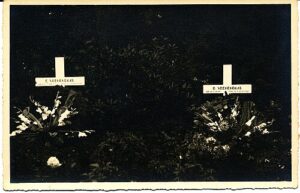
Death and burial ground of Barend “Bab” and Elbert Veendaal.
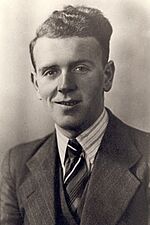
The Veenendaals and the others were held at De Wormshoef in Lunteren for the first few days before being transported to Camp Amersfoort. 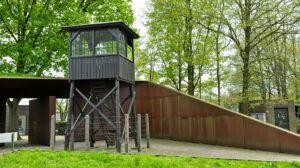 On 14-03-1945, in Amersfoort, the “collaborator” policeman Diederik Lutke Schipholt was shot dead by the resistance. Schipholt was a fierce Jew hunter. Due to his activities, among others Jacob de Graaf, age 42,
 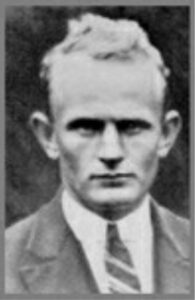 and Luitzen van der Weij
 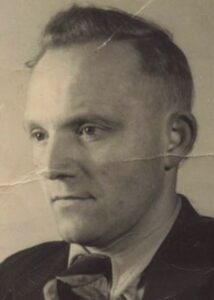 were arrested and died. Jacob de Graaf was involved in the resistance of the Westerkerk group, offers help to people in hiding, and distributes Vrij Nederland and Trouw. On 02-06-1944, he was arrested for these activities at the address Prinses Marielaan 30, the address of the Van Heemstra family, after being betrayed by his secretary. Jaap was transferred to Neuengamme via Utrecht, Vught, and Sachsenhausen. There he was registered under number 58239. On 09-12-1944, Jaap, age 42 passed away in Engerhafe, an external camp of Neuengamme.
Luitzen “Luit” van der Weij born on 29-10-1905, in Ferwerderadeel. He is married to Antje Zwaan, and together they have three children. Luit is the caretaker of the Westerkerk and after Hans Westera went into hiding, he became the district leader of the LO and worked from the Westerkerk. Due to betrayal, Luit and Jacob de Graaf were arrested on 02-06-1944, for aiding hiding Jews and distributing the illegal newspaper Trouw. He was imprisoned in the jail in Utrecht and transferred via the camps Vught, Sachsenhausen, and Bergen-Belsen to Neuengamme, where he was registered under number 74860. He is assigned to work at Bremer-Farge, a German naval base on the Weser, and died there from exhaustion on 18-03-1945.
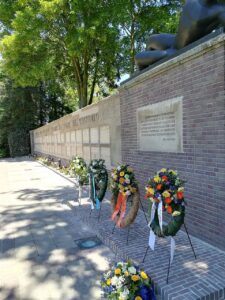
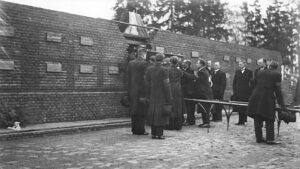
After the war, the bodies of both brothers Veenendaal were interred in The Mausoleum in Ede.
The Mausoleum on the Paasberg in Ede was established in memory of 44 local resistance fighters who fell during World War II in the struggle against the occupier. In the grave monument, 30 war victims are buried. The names of the war victims buried here are: Simon Bent, Abraham Bois, Hendrik Dorrestijn, Lambertus Elst, Cornelis Garritsen, Pieter Rutger Geest, Derk Gestel, Christiaan Hollebrands, Johannes Kelderman, Leonard Gerard Lambert, Maarten Henricus Lugthart, Jan Mekking, Pieter Lambertus Merlijn, Hendrik Mheen, Willem Mheen, Ferdinand Rombout, Folkert Gijsbertus Roosjen, Peter Roseboom, Jan Willem Schouten, Piet Smit, Martijn Steenbergen, Elbertus Steenbergen, Aart Steenbergen, Rijk Tigelaar, Pieter Adriaan Vark, Egbert Luten, Gerrit Veen, Barend Veenendaal, Cornelis Verdwijn, and Hielke Vliet.


Leave a Reply