


Kovner, Abba, born 14-03-1918, in Ashmyany, 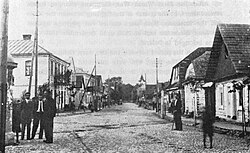 Lithuania District, German Empire, to Israel Kovner, and Rochel (Rosa), born Taubman, whose other sons were Gedalia and Michel, the youngest of them. In 1927, the family moved to Popławska Street in Vilnius (then Poland, now Lithuania).
  Abba Kovner was educated at the Hebrew Tarbut Gymnasium
 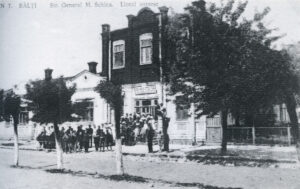 and Stefan Batory University’s Faculty of Arts.
 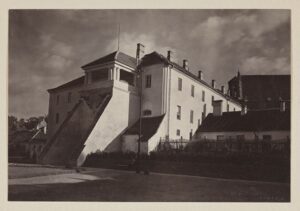 His father had a shop in Vilnius selling leather on Julian Klaczko Street. While pursuing his studies, Abba became an active member in the socialist Zionist youth movement HaShomer HaTzair.
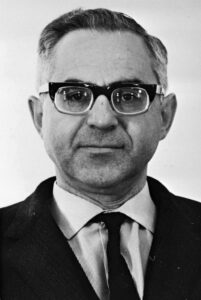
  Abba Kovner was a cousin of the Israeli Communist Party
  leader Meir Vilner.
  .
.
During the 1939 invasion of Poland, Vilnius, where Kovner lived, fell first to the Soviet Union and was then transferred to Lithuania, later in 1940 it became part of the Soviet‑occupied Lithuanian SSR, and in 1941, Nazi Germany invaded the Soviet Union and captured Vilnius from the Soviets. All Jews were ordered by the occupiers to move into the Vilna Ghetto, but Kovner managed to hide with several Jewish friends in a Dominican convent headed by Polish Catholic nun Anna Borkowska 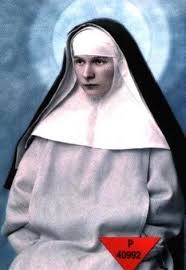
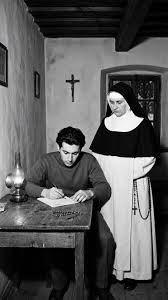 in the city’s suburbs. He soon returned to the ghetto. Kovner concluded that in order for any revolt to be successful, a Jewish resistance fighting force needed to be assembled.
At the start of 1942, Kovner released a manifesto in the ghetto, titled “Let us not go like lambs to the slaughter!”, although the authorship has been contested. The manifesto was the first instance in which a target of the Holocaust identified that Adolf Hitler had decided to kill all the Jews of Europe, and the first use of the phrase “like sheep to the slaughter” in a Holocaust context. Kovner informed the remaining Jews that their relatives who had been taken away had been murdered in the Ponary massacre 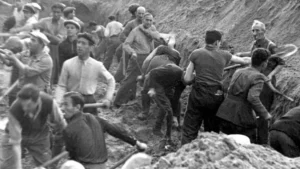 and argued that it was best to die fighting. Nobody at that time knew for certain of more than local killings, and many received the manifesto with skepticism. For others, this proclamation represented a turning point in an understanding of the situation and how to respond to it. The idea of resistance was disseminated from Vilnius by youth movement couriers, mainly women, to the ghettos from the now occupied territories of Poland, Belarus and Lithuania.
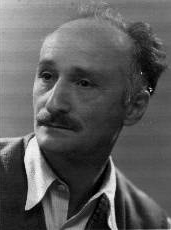
Kovner, Yitzhak Wittenberg, 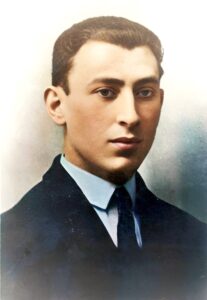 Alexander Bogen
  and others formed the Fareynikte Partizaner Organizatsye (FPO),
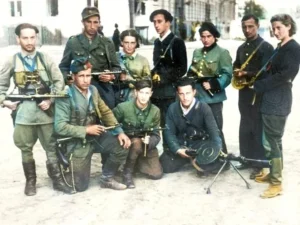 one of the first armed underground organizations in the Jewish ghettos under Nazi occupation. Kovner became its leader in July 1943, after Wittenberg was named by a tortured comrade and turned himself in to prevent an attack on the ghetto. The FPO planned to fight the Germans when they would come to dissolve the ghetto, but circumstances and the opposition of the ghetto leaders made this impossible and they escaped to the forests.
From September 1943 until the return of the Soviet army in July 1944, Kovner, along with his lieutenants Vitka Kempner who passed away, age 91 in Israel on 15-02-2012 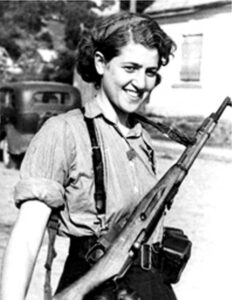
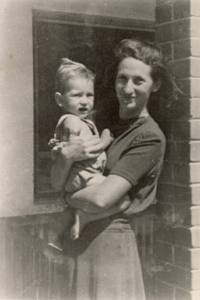
 far right on the photo above and Rozka Korczak or Ruzka Korczak,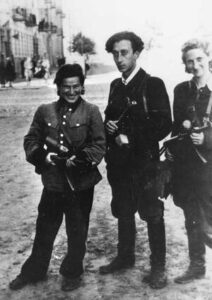
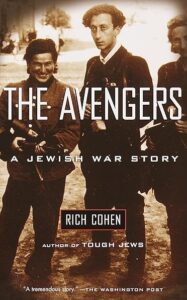 commanded a partisan group called the Avengers (“Nokmim” in Hebrew) in the Rūdninkai forest near Vilnius and engaged in sabotage and guerrilla attacks against the Germans and their local collaborators. The Avengers were one of four predominantly Jewish groups that operated within the command of the Soviet-led partisans, and they did significant damage, destroying over 180 miles of train tracks, 5 bridges, 40 enemy train cars, killing 212 enemy soldiers and rescuing at least 71 Jews. A log of partisan activity recorded that 30 fighters from “Avengers” and “To Victory” partisan groups participated in the massacre of at least 38 civilians at Koniuchy in January 1944.
After the Soviet Red Army occupied Vilnius in July 1944, Kovner became one of the founders of the Berihah movement, helping Jews escape Eastern Europe after the war. 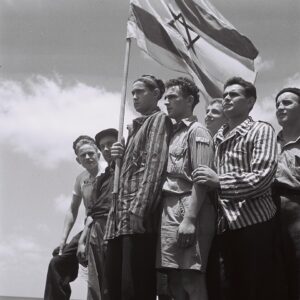
At the end of the war, Kovner was one of the founders of the secret organization Nakam (‘Revenge’), also known as Dam Yisrael Noter (‘the blood of Israel avenges’, with the acronym DIN meaning ‘judgement’), whose purpose was to seek revenge for the Holocaust. Two plans were formulated, with the goal being to kill six million Germans. Plan A was to kill a large number of German citizens by poisoning the water supplies of Hamburg, Frankfurt, Munich, and Nuremberg. Plan B was to kill SS  prisoners held in Allied POW camps. In pursuit of Plan A, members of the group were infiltrated into water and sewage plants in several cities, while Kovner went to Palestine in search of a suitable poison. Kovner discussed Nakam with Yishuv leaders, though it is not clear how much he told them, and he does not seem to have received much support. According to Kovner’s own account, Chaim Weizmann
 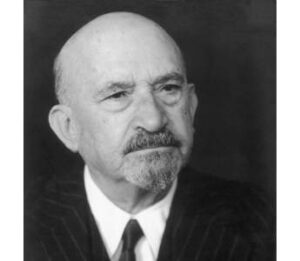 approved when he pitched Plan B and put him in touch with the scientist Ernst Bergmann,
 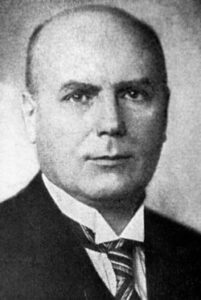 who gave the job of preparing poison to Ephraim Katzir
 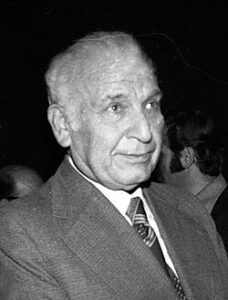 (later president of Israel) and his brother Aharon.
 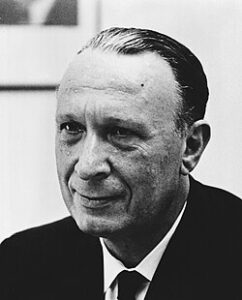 Tom Segev
 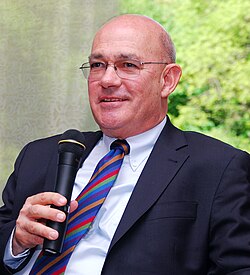 initially expressed doubt over Weizmann’s involvement, but in a 2025 interview he recanted his doubts, stating: “Years later, [historian] Dina Porat discovered that Kovner had received the poison from Ephraim Katzir [a leading scientist in the institute founded by and in the name of Weizmann, later Israel’s president]. How narrow-minded and square I was.”
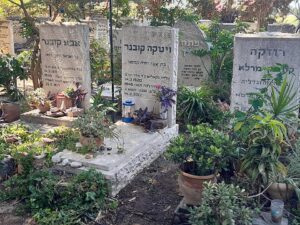
Death and burial ground of Kovner, Abba.
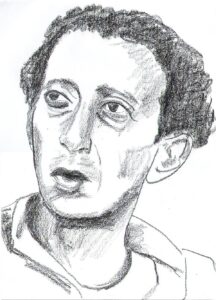
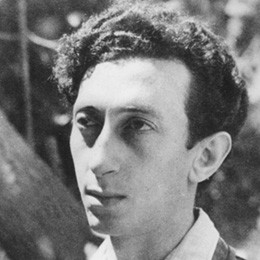
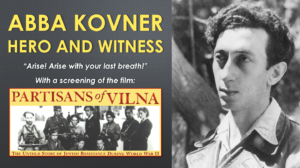
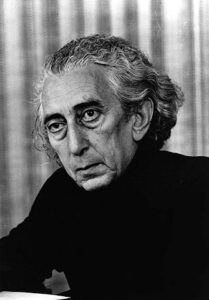
From 1946 to his death, Kovner was a resident of Kibbutz Ein HaHoresh. He was active in Mapam as well as in HaShomer HaTzair, but never took on a formal political role. He played a major part in the design and construction of several Holocaust museums, including the Diaspora Museum in Tel Aviv.  25-09-1987 (aged 69) of laryngeal cancer, perhaps due to his lifelong heavy smoking, at his home in Ein HaHoresh. in Ein HaHoresh, Israel. He was survived by his wife Vitka Kempner, who married Kovner in 1946, and their two children. Abba is buried at the Ein HaHoresh Cemetery in the Central District of Israel.
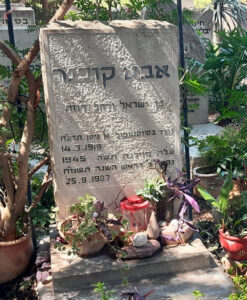 Graves_of_Abba_Kovner_Vitka_Kempner_and_Rozka_Korczak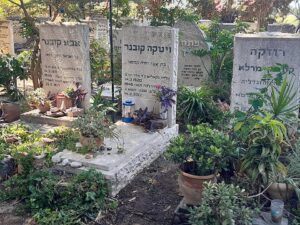




Leave a Reply