


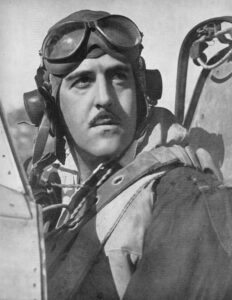
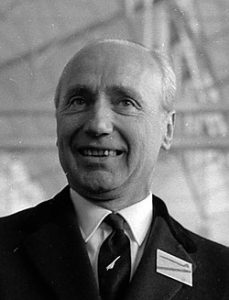
Caldwell, Clive Robertson “Killer”, born 28-07-1910 in Petersham, Inner West Council, 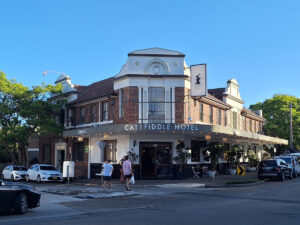 New South Wales, Australië, tthe only child of New South Wales-born parents John Caldwell, banker, and his wife Annie Selina, born Smiles. Clive was educated at Balmain Public School and at Trinity and Sydney Grammar schools before entering the Bank of New South Wales in 1928.
 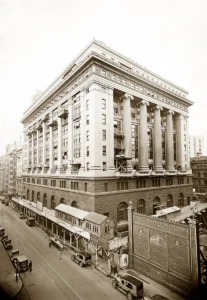 Resigning in 1931, he worked as a jackeroo for two years then operated a garage at Darlinghurst with a friend. In 1937 he joined the Mutual Life & Citizens Assurance Co. Ltd and on 13-04-1940 he married Jean McIver Main, a nurse who had trained at Wootton private hospital, Kings Cross. The ceremony took place at a small chapel located on the Main family’s grazing property, ‘Retreat,’ close to Cootamundra. Clive Caldwell learned to fly with the Aero Club of New South Wales,
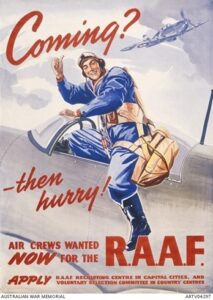
  before enlisting in the Royal Australian Air Force (RAAF)
  on 27-05-1940. Mistakenly believing he was too old to be a fighter pilot, he understated his age. He trained in Australia under the Empire Air Training Scheme (EATS).
  Commissioned in January 1941, Caldwell embarked for the Middle East on 3 February. After a brief attachment to 73 Squadron, Royal Air Force, he transferred to 250 Squadron, RAF,
  flying P-40 Tomahawk fighters.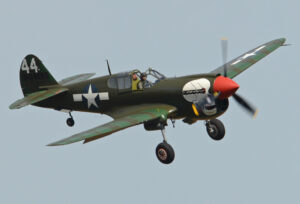
In July 1941 Caldwell was promoted to flying officer and two months later to acting flight lieutenant. His score of destroyed enemy planes mounted and he acquired the sobriquet ‘Killer,’ which he despised. After five aerial victories he became an ace and was awarded the Distinguished Flying Cross  for his ‘splendid work in the Middle East operations’ (London Gazette, 26-12-1941, 7298). On 5 December he accounted for five Junkers Ju 87
  dive bombers in a matter of minutes, for which he was awarded a bar to his DFC. Although his fellow pilots disapproved of his ‘lone wolf’ attacks on the enemy, he demonstrated leadership potential and, on 21 December, was appointed commanding officer of No. 112 Squadron, RAF.
  Flying P-40 Kittyhawks,
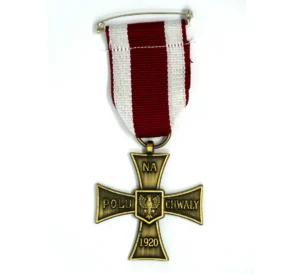
 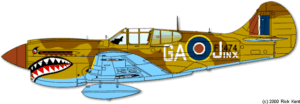 he was promoted to acting squadron leader in January 1942. His aggressive leadership resulted in personal and squadron success, and he left the Middle East in May as the top-scoring desert fighter pilot and leading Kittyhawk ace. He was later awarded the Krzyz Waleoznych (Polish Cross of Valour)
 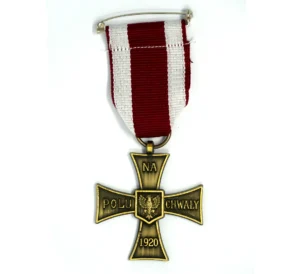 in recognition of his ‘buoyant co-operation’ with the Polish pilots of No. 112 Squadron. After a posting to 2 Operational Training Unit, Mildura, Victoria, where he was appointed chief instructor, Caldwell returned to Darwin in May 1944 to command 80 Fighter Wing,
  equipped with Spitfires.
 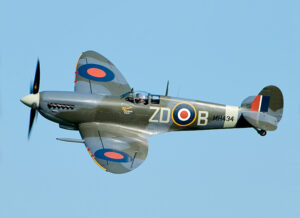 On 1 August he was promoted to acting group captain. In December, as part of the First Tactical Air Force, 80 Wing
 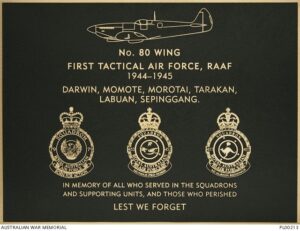 deployed to Morotai Island, Netherlands East Indies (Indonesia), for night-fighter defence. RAAF infrastructure was at first wanting and Caldwell used his personal liquor store to trade goods and services with the Americans who were based nearby. This contravened Air Board orders and, in April 1945 under section 40 of the Air Force Act, he faced court-martial. Simultaneously, he and seven other RAAF officers who were critical of the futile operations they had been required to carry out attempted to resign from their commissions.
Death and burial ground of Caldwell, Clive Robertson.
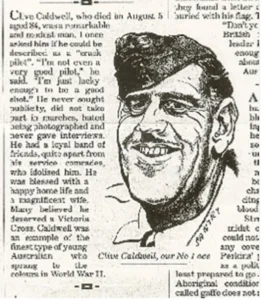
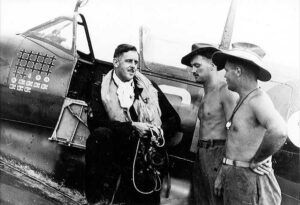
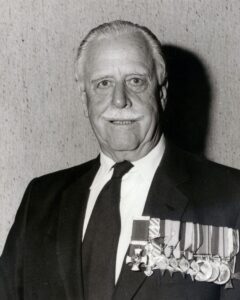
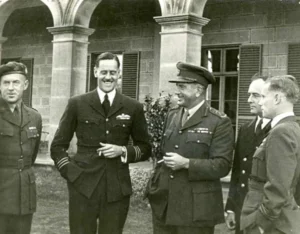 Clive Caldwell and Ron Cundy, Smokey Lumley and Lyn Compton.
Returning to civilian life Caldwell engaged in a number of enterprises, including importing surplus aircraft and other military equipment. He joined a cloth import/export company in Sydney eventually becoming its managing director. Later he became a partner and in 1957 established Clive Caldwell (Sales) Pty Ltd, a successful enterprise specialising in fabrics. Shunning publicity, he disliked being photographed, refused to participate in marches, and did not want his biography written. A keen golfer, he was a member of the Royal Sydney Golf Club.  Clive Robertson Caldwell passed away on 05-08-1994 at Darlinghurst and was cremated. His wife survived him; the couple had no children. Acknowledged as Australia’s highest-scoring fighter pilot of World War II, with an official tally of 27½ destroyed enemy aircraft, Caldwell received many public tributes.
Message(s), tips or interesting graves for the webmaster: robhopmans@outlook.com






Leave a Reply