

Velde, Pieter “Piet” Cornelis Marinus van de, born 23-04-1897, in shipping and shipbuilding town Vlissingen, 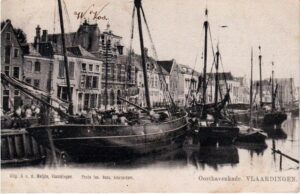 Netherlands. Van de Velde was married to Ida Nebbeling (1902-1988). Together they had five children. Van de Velde worked as a ship’s doctor and internist before the war. He became the medical director of the Bethesda Hospital in Hoogeveen
 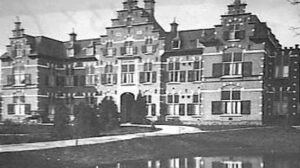 in 1943, where he was already employed. Van de Velde was a declared opponent of National Socialism. During the war, he provided shelter in his house at Pesserstraat 1 in Hoogeveen, and in the hospital, to Jews, Allied pilots, and illegal workers. Van de Velde often registered them as scabies patients, a skin condition that can easily be transmitted. In this way, Van de Velde hoped to keep the Germans at bay.
The hospital also took in Jewish patients from Camp Westerbork. 
 Van de Velde tried to keep them in the hospital for as long as possible and then have them go into hiding. The magazine Vrij Nederland
 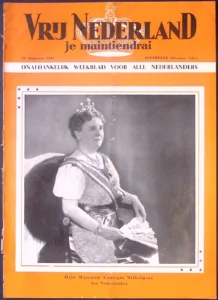 was also distributed from the hospital. Police officer and helper of the Sicherheitsdienst
  Hendrik de Kruijff
 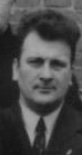 did harbor suspicions against Van de Velde, but could not substantiate them.
In December 1944, Van de Velde and head nurse Martje Posthuma received a request to provide shelter for an illegal radio station. The transmitter was initially housed in the Reformed Church on Hooftweg, 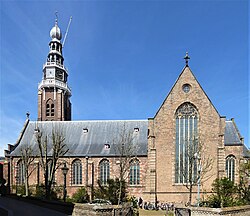 but that location was no longer considered safe. The hospital was an ideal location because the steam supply was stable. Van de Velde had difficulty with the request because he saw the hospital as a neutral location. By placing the transmitter, there would be “active” resistance from the hospital, which Van de Velde considered different from providing assistance to those in need. Van de Velde was, however, put under such pressure by the resistance that he agreed.
The transmitter was installed and operated by Jacob van der Hul, alias Radio Kees, 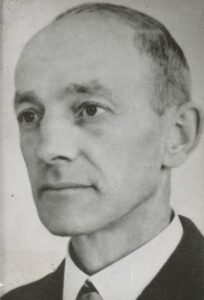 on 11-01-1945. However, the presence of the transmitter was too noticeable, so after a few days it was moved again to the home of Roelof Eising in Drijber, who lived on the premises of the Waste Disposal Company. Living with the family in the house was Geessien Bleeker.
 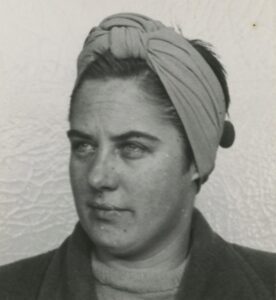 She had betrayed a number of resistance members in Groningen a few months earlier. The resistance did suspect her of that, but could not substantiate the suspicions. Therefore, it was decided to arrest her. Because she had changed addresses multiple times, the Eising family did not know that she was a “prisoner.” They only knew that Bleeker was being sought by the SD. Van der Hul therefore confided in her and spoke about his experiences in Hoogeveen, mentioning the name of Van de Velde in the process.
The Germans discovered the transmitter in Drijber and traced it. On 09-02-1945, a raid took place. Bleeker immediately defected back to the German side and pointed out the hiding place of radio operator Antonie Hendrik Stam 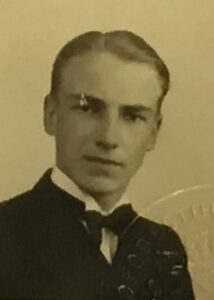 to the SD. Ten men and women formed the leadership in October 1941 of what would grow into the most important resistance newspaper, Vrij Nederland. In the following months, almost all of them ended up before a firing squad or in a cell. The survivors told their war stories after the liberation. Except for that one deemed unreliable Zaanstad resident, Anton Stam. Anton Stam passed away on 09-01-1998.
Shortly thereafter, Geessien Bleeker named the individuals involved who were arrested in the following days. No action was initially taken against Van de Velde, so he felt safe. On 28-02-1945, a raid did take place after all. Van de Velde was arrested by the SD officer Jan Lammerts. His wife was elsewhere at that moment, but hurried home quickly, where she still found her husband. She was not allowed to speak to him.
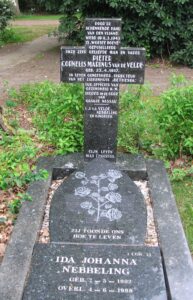
Death and burial ground of Velde, Pieter “Piet” Cornelis Marinus van de.
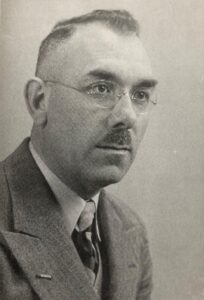
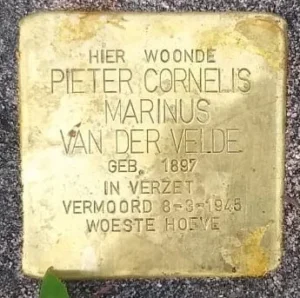 Van de Velde was transferred to the House of Detention in Assen.
 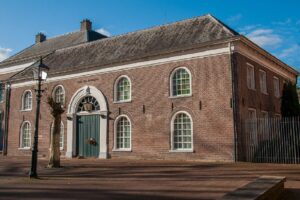 On the nite of March 6 to 7, 1945, SS officer Johan Albin Baptist “Hanns” Rauter,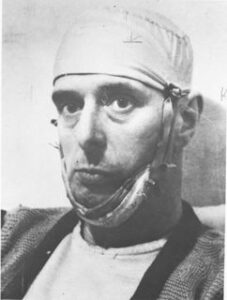
 the German leader of the police in the Netherlands, was seriously injured in a random attack at the Woeste Hoeve in the eastern Veluwe.
 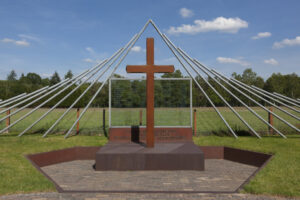 On 08-03-1945, the German occupiers executed 117 prisoners at the site of the attack in retaliation, including Van de Velde age 47.
From the Israeli Holocaust center Yad Vashem, 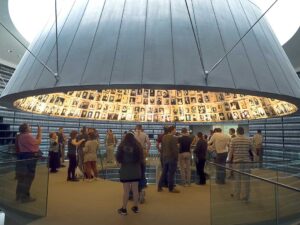 Van de Velde posthumously received the honorary title Righteous Among the Nations
 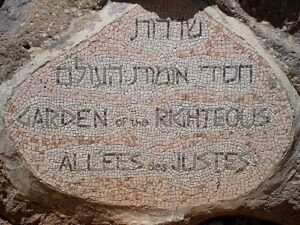 in 1979 for his help to Jews during the war.
Pieter “Piet” Cornelis Marinus van de Velde is buried at the Jewish Cemetery at the west side of the Zuiderweg, Hoogeveen (grave 0209) Netherlands.





Leave a Reply