


Steiner, Felix Martin Julius, born 23-05-1896 in Ebenrode  who’s father was a teacher, who died in December 1916. On 09-03-1914 Steiner passed his abitur. He volunteered for the Prussian army and was posted to the Infanterie-Regiment „von Boyen“. Steiner served as an officer during the First World War, reaching the rank of Oberleutnant, and winning the Iron Cross First and Second Class.
  He left the army after the war, and joined a Freikorps,
  but rejoined the army in 1921. He served with Infanterie-Regiment 1 before being appointed to the General Staff from 1921-1927. In 1927 he was promoted to Hauptmann, and appointed Regimental Adjutant of Infanterie-Regiment 1, and in 1932 he was promoted to command a company in the same regiment.
In the mid 1930s Steiner’s career developed unusually for an established officer. In 1933 he took part in the creation of the Kasernierte Polizei (Barracked Police),  a paramilitary police force manned by members of the existing Landespolizei,
 and intended to act as a reserve for the regular army. He joined the NSDAP, NSDAP-nr.: 4 264 295 on 01-01-1934. In 1935 he went one step further, and volunteered to join the SS-Verfüngungstruppe (precursor to the Waffen SS), SS-nr.: 253 351. He was appointed command of III.Bataillon, SS-Standarte Deutschland
  ,
,  and in 1936 was promoted to command the entire regiment.
The regiment took part in the Anschluss with Austria, 
 while during the invasion of Poland in 1939 it was attached to Panzer Division ‘Kempf’, as the Waffen-SS was still a tiny organisation. Steiner’s men took part in the attack on Deplin on the Vistula, before helping to capture the fortress of Modlin on 28-09-1939. Steiner was awarded the Clasps
  to both of his Iron Crosses for his success at Modlin.
In the aftermath of the Polish campaign the Deutschland, Der Führer and Germania regiments of the Waffen-SS were brought together with a number of smaller units to form the SS’s first divison – SS-Verfügungs-Division. In the first phase of the campaign in the west in 1940 this division advanced on the German right, and Steiner’s men captured the islands of Seeland, Vlissingen and Beveland. In the second part of the campaign they were able to break through the Weygand Line, and advanced deep into France. Steiner was awarded the Knight’s Cross on 15-08-1940 for his part in this success.
The Waffen-SS continued to expand, and on 01-12-1940 SS-Brigadeführer  Steiner was appointed to command the new Wiking Division.
  This unit was mainly manned by non-German volunteers, mainly from Holland, Denmark and Sweden, motivated by a desire to fight the Bolsheviks. Steiner proved to be a skillful divisional commander, and was vey popular with his men. Steiner commanded this division during the first two years of the fighting in the Soviet Union, and was awarded the Oakleaves to the Knight’s Cross on 23-12-1942.
With SS Brigade Führer Gotthard Heinrici as Commander-in-Chief of Army Group Vistula Steiner was transferred with most of the III SS Panzer Corps’s divisions to General der Infanterie, Chef des Generalstabes Heeresgruppe Süd, Theodor Busse´s 
 German Ninth Army. Steiner had always been one of Hitler’s favorite commanders, who admired his ‘get the job done’ attitude and the fact that he owed his allegiance to the Waffen SS, not the Prussian Officer Corps. Joseph Goebbels (did you know) also praised Steiner. “He is energetic and purposeful and is attacking his job with great verve,” Goebbels wrote on 01-03-1945. By 21 April, Soviet Marshal, Georgi Zhukov´s
 1st Belorussian Front had broken through the German lines on the Seelow Heights. Adolf Hitler, ignoring the facts, started to call the ragtag units that came under Steiner’s command Army Detachment Steiner. An army detachment was something more than a corps but less than an army. Hitler ordered Steiner to attack the northern flank of the huge salient created by the 1st Belorussian Front’s breakout. In conjunction with Steiner’s attack, the Ninth Army under General Theodor Busse, was to attack from the south in a pincer attack. The Ninth Army had been pushed to south of the 1st Belorussian Front’s salient. To facilitate this attack, Steiner was assigned the three divisions of the Ninth Army’s CI Army Corps: the 4th SS Polizei Division
  , the 5th Jäger Division and the 25th Panzer Grenadier Division, nickname Stuttgarter Haus Division .
  All three divisions were north of the Finow Canal on the Northern flank of Zhukov’s salient. Weidling’s LVI Panzer Corps, which was still east of Berlin with its northern flank just below Werneuchen, was also to participate in the attack. The three divisions from CI Army Corps were to attack south from Eberswalde on the Finow Canal towards the LVI Panzer Corps. The three divisions from CI Army Corps were 24 kilometres, about fifteen miles, east of Berlin and the attack to the south would cut the 1st Belorussian Front’s salient in two. Steiner called Heinrici and informed him that the plan could not be implemented because the 5th Jäger Division
  under command of Generalleutnant Edmund Blaurock,

 and the 25th Panzer Grenadier Division under command of Generalleutnant Arnold Hans Albert Burmeister
 were deployed defensively and could not be redeployed until the II Naval Division arrived from the coast to relieve them. Burmeister survived the war and died 02-07-1988. Steiner, Felix Martin, born on 23-05-1896 in Stallupönen, East Prussia. In 1914, on the eve of war, joined the Prussian Officer Corps
  as a cadet. During the course of the war, he earned the Iron Cross first and second class and finished the war as an Oberleutnant. After the war, Steiner led a unit of Freikorps
  in the East Prussian city of Memel. He rejoined the army in 1922 and by 1933 had attained the rank of Major. After the NSDAP
  takeover, Steiner joined the Reichswehr staff and began work developing new training techniques and tactics. The outbreak of war saw Steiner as an SS-Oberführer
  and still in charge of the SS-Deutschland. He led his regiment well through Invasion of Poland and the Battle of France, earning the Knight’s Cross of the Iron Cross on 15-08-1940. Steiner was described as a “hard driving leader of men”. He had his men trained to be athletic, and drilled to march three Kms in twenty minutes! As part of his plan to promote a team spirit, he ordered that no SS trooper’s locker, cupboard or barracks be locked, as a matter of principle. Under Steiner’s command, 40% of SS officer cadets had not matriculated, but they had to pass an equivalent standard at the cadet schools.


 After the early war campaigns, Steiner on 01-07-1943 promoted to SS Obergruppenführer
  was chosen by SS-Reichsführer, Heinrich Himmler
  to oversee the creation of, and then command the new volunteer SS Division, 5. SS-Panzer-Wiking . The Wiking was made up of Non-German volunteers, and at the time of its creation consisted mostly of Dutch, Walloons, and Scandinavians including the Danish regiment Frikorps Danmark.
  In January 1945, Steiner along with the III SS Panzer Corps was transferred from the Courland Pocket to help with the defence of the German homeland. Steiner received the Knight’s Cross of the Iron Cross with Oak Leaves and Swords
  on 23-12-1942.

 His successor was SS Obergruppenführer, Herbert Gille.
  The III SS Panzer Corps
  was assigned to Army Group Vistula and put under the new Eleventh SS Panzer Army, although this army really only existed on paper. Once the Soviets reached the Oder, Eleventh SS Panzer Army became inactive and the III SS Panzer Corps was re-assigned to the German Third Panzer Army as a reserve during the Soviets’ Berlin Offensive Operation. During the Battle of Halbe, the first major battle of the offensive, Generaloberst der Panzertruppen, Gotthard Heinrici,
 he died age 84, on 13-12-1971. This left only two battalions of the 4th SS Police Division available and they had no combat weapons. Based on Steiner’s assessment, Heinrici called General der Infanterie, Chief of the Army General Staff (OKH), Hans Krebs, suicide age 57, on 01-05-1944, Chief of Staff of the German General Staff of the High Command of the Army,OKH and told him that the plan could not be implemented. Heinrici asked to speak to Hitler, but was told Hitler was too busy to take his call. On 22-04-1945, at his afternoon conference, Hitler (see Adolf Hitler) (did you know) became aware that Steiner was not going to attack and he fell into a tearful rage. Hitler declared that the war was lost, he blamed the Generals, and announced that he would stay on in Berlin until the end and then kill himself. On the same day, Generalleutnant der Artillerie, Kommandeur der XXXXI Panzerkorps, Rudolf Holste was given what few mobile forces Steiner commanded so that he could participate in a new plan to relieve Berlin. Holste was to attack from the north while General der Panzertruppen, commander the German Twelfth Army, Walter Wenck
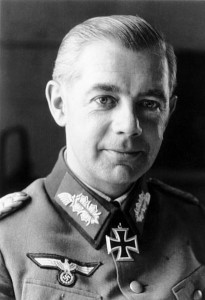
 attacked from the west and General, Chef des Generalstabes Heeresgruppe Süd, Theodor Busse attacked from the south. These attacks amounted to little and, on 27 April, the Soviet forces attacking to the north and to the south of Berlin linked up to the west of the city. Steiner surrendered to the British at Luneburg on 3 May. After the surrender, Steiner was incarcerated until 1948. He faced charges at the Nuremberg Trials, but they were all dropped and he was released.
Death and burial ground of Steiner, Felix Martin Julius.


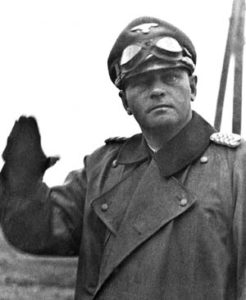
 He dedicated the last decades of his life to writing his memoirs and several books about the war. Steiner here with General of the Fallschirmjäger/Airbornes Hermann Bernard Ramcke and SS Obergruppenführer Herbert Gille
  spent his last years in Munich, where he enjoyed meeting with a small company of close friends and wartime associates. On 16-03-1966, shortly before his 70th birthday, the former SS Obergruppenführer died of heart failure. He never married.and is buried on the cemetery Perlacher Forst in Munich, close to the war victims/resistance, brother and sister Hans and Sophie Scholl

 the “Weissen Rose” resistance group, condemned, to death on the guillotine, by Nazi jurist, Ronald Freisler.

 His funeral was attended by hundreds of his men who came from all over Europe to pay their last respects.


Message(s), tips or interesting graves for the webmaster: robhopmans@outlook.com


Leave a Reply