

Terrell Henry, Jr. born 14-10-1890 in San Antonio, Texas;  the youngest son to Judge Henry Terrell Sr. (1860-1931)
  a local and well respected Judge in San Antonio and his wife Kate Rivers, born Brahan (1856-1942). Both his parents could trace their ancestry back to Colonial Virginia and his father’s ancestors were prominent military members. Henry studied at the University of Texas from 1908 to 1912. However, as there are several universities in Texas with this designation and no precise details are given in the sources, it remains unclear at which of these universities he studied. Henry had one sister and one broteher, Cornelia Terrell Keefer (1885–1957)
  and Robert Weakley Brahan Terrell (1889–1988). Henry was married to Helen, born Gunther Terrell (1891–1972)
In 1912, he joined the officer corps of the US Army,  where he was assigned to the infantry. In the army, he subsequently passed through all officer ranks from lieutenant to two-star General. In the course of his military career, Terrell completed various courses and training programs. These included the Command and General Staff College and the United States Army War College.
In his younger years, he served in various units and locations as an officer in the lower ranks. This included assignments as a staff officer at various headquarters. In the meantime, he was stationed at the Panama Canal and served on the border to this neighboring state during the Mexican Expedition.  The Mexican Expedition, also known as the Punitive Expedition or Pancho Villa

 Expedition under the command of General John Joseph „Black Jack“ Pershing,
 was a US Army military operation conducted between 14-03-1916 and 07-02-1917 in the northern Mexican state of Chihuahua.
From the summer of 1918, he took part in the final phase of the First World War as part of the American Expeditionary Forces.  He served in an infantry regiment and was involved in several battles, including the Battle of the Marne, the Battle of St. Mihiel and the Meuse-Argonne Offensive.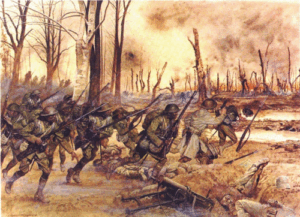
After the war, Terrell continued his officer career in the 1920s and 1930s at various locations and in various functions.
At that time he graduated from the schools mentioned above. From 1936 to 1938, he commanded the 9th Infantry Regiment.  This was followed by a transfer to the staff of the Ministry of War, to which he belonged until February 1941.
During World War II Terrell briefly commanded the 8th Infantry Division  in March 1941. By March 1942, three months after the Japanese attack on Pearl Harbor
  and the subsequent American entry into the war, he was promoted to the two-star rank of Major General and was the first Commanding General (CG) of the 90th “Tough Ombres” Infantry Division. The division was composed mostly of conscripts (or draftees) who were new to military service. His Assistant Division Commander (ADC) was Charles W. Ryder until January 1943 when Alan W. Jones succeeded him.
Terrell led the division in numerous training exercises in the United States. However, the division, which later went on to fight in the Battle of Normandy, was considered by many senior American commanders (namely Major General Joe Collins, the VII Corps commander, and Lieutenant General Omar Bradley, then the commander of the U.S. First Army, who stated that the 90th  was “one of the worst-trained outfits to arrive in the ETO”) to have performed poorly in the opening stages of the campaign. Much of the blame for this was placed on, not the current commander, Brigadier General Jay Ward MacKelvie,
 but on Terrell. In mid-January 1944, he was promoted (although without change in rank) to command of the newly created XXII Corps
  in the United States. However, he never led the corps in combat as, in November 1944, Terrell was ordered to command the Infantry Advanced Replacement Training Center
  until the end of the war. Major General Ernest Harmon,
  a highly experienced and competent commander, became CG of XXII Corps. For his services in raising the 90th Infantry Division Terrell was awarded the Army Distinguished Service Medal,
  the citation for which reads:
The President of the United States of America, authorized by Act of Congress 09-07-1918, takes pleasure in presenting the Army Distinguished Service Medal to Colonel (Infantry), [then Major General] Henry Terrell, Jr. (ASN: 0-3264), United States Army, for exceptionally meritorious and distinguished services to the Government of the United States, in a duty of great responsibility as Commanding General, 90th Infantry Division and later as Commanding General XXII Corps, from 1942 to 1945.
The casualities of the 90th Infantry Division during the European campaign. Total battle casualties: 19,200, killed in action: 3,342, wounded in action: 14,386, missing in action: 287 and prisoners of war: 1,185.
Death and burial ground of Terrell Henry, Jr.


Major General Henry Terrell Jr. retired from the army on 30-04-1946, almost a year after the end of World War II in Europe, and died on 03-10-1971, age 80, in San Antonio, Texas, his birthplace. He is buried together with his wife Helen (1891–1972) at Fort Sam Houston National Cemetery. Section X, 1075.




Leave a Reply