


Macdonald, Charles Lloyd, born 10-10-1918, at Pictou, Nova Scotia, Pictou,  Canada, the second child and eldest son of Leonard and Margaret May, born McLean, MacDonald. Leonard was also a Pictou native, while Margaret was born at De Gros Marsh, PEI, the daughter of Bernard and Isabel (McCabe) McLean. The couple married at Georgetown, PEI, on 18-10-1916, and established their first home at Pictou, where Leonard worked as a freight checker for the Intercolonial, later Canadian National Railway.
During the course of their marriage, Leonard and Margaret welcomed eight children—five boys and three girls—into their home. Four of their five sons entered military service during the World War II. Leonard Jr. followed in his eldest brother Lloyd’s footsteps and joined the Royal Canadian Air Force  in June 1942. He was stationed at a radar base near Sydney, Nova Scotia, throughout the conflict. Following the war’s end, Leonard remained in uniform, serving primarily with the Mechanical Equipment Section (Heavy Equipment and Refueling)
  at various RCAF locations across the country for more than two decades. Following his retirement from military service in April 1968. Leonard returned to the Antigonish area, where he passed away on 04-09-2003.
A second son, Lewis Vincent, joined the Canadian merchant marine at Halifax in February 1945, and served at sea without incident for the remainder of the war. Upon returning to civilian life, Lewis married and resided in his wife’s home community of Mulgrave, where the couple raised a family of nine children. He was employed at a nearby local pulp and paper mill. Lewis passed away at Mulgrave on 20-03-1993.
A third son, Gordon Francis “Yits,” enlisted with the Royal Canadian Navy  in August 1944 and also served at sea during the war’s final months. Following his discharge, he married and settled in Antigonish, where he raised a family of six children. Gordon was employee of the Angus L. MacDonald Library, St. Francis Xavier University.
  Gordon passed away at Antigonish on 22-08-2004.
Charles Lloyd completed his elementary and secondary education at Morrison School, graduating in 1939. His Principal, J. P. MacInnis, later provided this assessment on his Royal Canadian Air Force application: “I have found him entirely trustworthy, honest and upright. A good student, interested in all activities of the school, he was often a leader in student activities.”
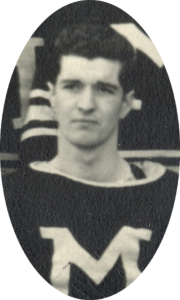
Lloyd was an accomplished athlete, serving as Captain of the Morrison School hockey team for two years. He was also a member of the 86th Field Battery, Canadian Field Artillery,  a local militia unit, and earned a Certificate of Qualification, 2nd Class, in Visual Telegraphy during almost five years of service.
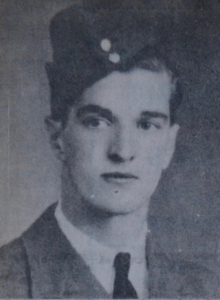
After the outbreak of the Second World War in September 1939, Lloyd applied to join the RCAF. Months passed before be received word of his acceptance. On 24-08-1940, he formally enlisted with the RCAF at Halifax, Nova Scotia, with the initial rank of Pilot Observer. His trade—“air crew pilot or observer”—indicates that the exact nature of his service was yet to be determined and would based be on his performance during training.
Two days after his enlistment, Lloyd was posted to No. 1 Manning Depot, Toronto, Ontario, the largest of seven RCAF facilities across the country. Located on the Central Canada Exhibition Grounds, the Depot contained accommodations for 5,000 personnel. Over a four to five week period, all recruits completed basic military training—physical drill, marching, rifle drill, saluting, etc.—at the Depot.
All ITS (No. 1 Initial Training School)  candidates completed a four-week instructional program that included such topics as navigation, theory of flight, meteorology, algebra, trigonometry, duties of an officer, and air force administration. Trainees also underwent a four-hour physical examination, a session in a “decompression chamber,” a lengthy interview with a psychiatrist, and a “test flight” in a Link Trainer. During their time at ITS, recruits were often assigned to “tarmac” duty and other tasks around the airfield, and held the rank of “Aircraftsman Second Class” (AC2).
On 01-04-1941, having successfully completed the SFTS (SYNTHETIC FLIGHT TRAINING SYSTEM ) training program with a rank of 18th in a class of 29 students, Lloyd received his Pilot’s Flying Badge. Nine days later, he was transferred to No. 1 Military Depot, Halifax, pending “appointment to a commission.” On April 11, Lloyd was officially promoted to the rank of Pilot Officer.
Death and burial ground of Macdonald, Charles Lloyd.
 On 21-09-1941, 129 Squadron
  “formed part of Escort Wing to [a] Bombing Raid on Gosnay [France]. Numbers of E/A [enemy aircraft] were encountered on the way into the Target and several combats ensued.” While 129 Squadron’s aircraft claimed to have destroyed six enemy Messerschmitts and damaged another five, three of its aircraft were lost during the aerial engagement. One pilot “was shot down into [the] sea but rescued.” The other two aircraft, piloted by “the Squadron Leader D. L. Armitage
 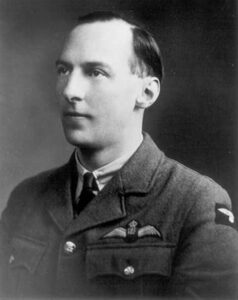 and Sergeant. [Lloyd] MacDonald (RCAF) were shot down and are missing.”
The remaining aircraft continued alongside with the bombers and escorted them safely back to base, “in spite of continuous attacks.” Later that day, Pilot Officer Charles Lloyd MacDonald was officially reported as “missing after air operations overseas.” For several months, his fate was unknown, although he was unofficially “presumed dead.”
A February 1942 news item in the Eastern Chronicle reported that Lloyd had posthumously received the Maharajah’s Medallion, 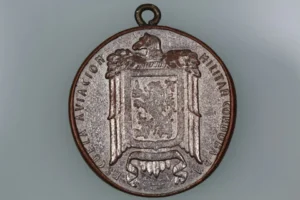 an award sponsored by 129 (Mysore) Squadron’s patron, H. H. the Maharajah of Mysore.
  One side of the medallion displayed an image of the double-headed eagle “Gunda Bherunda,” the Maharajah’s personal crest. The other bore his name.
On 18-07-1942, military authorities declared that Pilot Officer Charles Lloyd MacDonald was “officially presumed dead.” One month later, a Memorial Cross was dispatched to his grieving mother Margaret. The details surrounding Lloyd’s death remained a mystery until one month after V-E Day ( 08-05-1945), which brought an end to combat in Europe.
On 14-06-1945, Flight Lieutenant R. N. Archer filed a report into his investigation of the downing of Lloyd’s aircraft, Spitfire VB.P.8752. According to Archer’s report:
“I visited M. Dufour, an old Frenchman resident at Boulogne who was deported during the war for Resistance activities…. He told me that during the afternoon, about 1400 – 1500 hours on 21st September, 1941, an aircraft flew over Bimont on fire and finally crashed in the commune of Saint-Michel-sur-Bois [eight miles northeast of Montreuil, France, and approximately 70 kilometres west of its intended target]. The pilot was killed burned [sic] and was extinguished by a M. Daquin (who was also deported). M. Daquin took the Pilot’s ring (initials C.L.M), one identity disc, a piece of parachute, one “old Type” paper escape map. These were all given to M. Dufour, whereupon he gave them to me…. M. Daquin… stated the Germans put the body of the pilot in a coffin and transported it in the direction of [Bimont]. In [Bimont Par Hucqueliers] Cemetery in the British Military Section of the communal graveyard there is buried, in Grave 5, Section, 3, Group M… according to the cross: Aviateur Anglaix inconnu, No Date…. Grave No. 4 of this plot contains [a] body buried on 20-06-1941, and No. 6 [contains] a body buried on 21-10-1941. As the bodies were all buried in rotation, Grave No. 5 obviously contains [an] airman killed between these two dates by the German report[;] a process of elimination revealed this to be the grave of MacDonald. Remains to be verified at time of exhumation.”
A 13-12-1945 news item in The Casket provided further details as outlined in a letter from an RCAF Casualty Officer to Lloyd’s parents. According to sources, “the enemy attacked from out of the sun and with the advantage of surprise shot down several of the British aircraft, including those of Lloyd and his squadron commander.” Lloyd’s plane crashed in a small wooded area near Saint-Michel-sous-Bois and exploded upon impact.
German soldiers removed Lloyd’s remains and placed them in the Bimont par Hucqueiliers Cemetery, 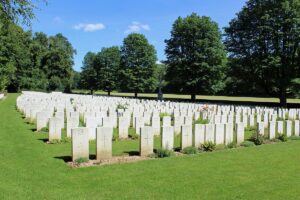 two miles northwest of the crash site. The villagers “placed a cross and flowers at the scene of the crash, and held a special service in the church which was attended by many people in the surrounding district.” Among the debris, a local resident found “a small leather purse containing some religious medals… with the name ‘Lloyd MacDonald’ written inside.”One week after these details were published in The Casket, noted local columnist Eileen Cameron Henry commented on the Lloyd’s tragic passing in her weekly “Around Town and County” column:
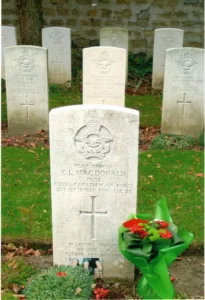
Almost five years later, Lloyd’s father received one final communication from military authorities. In a letter dated 27-09-1950, officials informed Leonard that his eldest son had been re-interred in Boulogne Eastern Cemetery, Boulogne, France, located on the French coastline. The reinterment occurred “so that the Imperial War Graves Commission (of which Canada is a member) could give perpetual care to his grave.” Sadly, Lloyd’s mother did not receive this comforting news. Margaret had passed away on 15-04-1950, the result of a cerebral haemorrhage.
Almost five years later, Lloyd’s father received one final communication from military authorities. In a letter dated September 27, 1950, officials informed Leonard that his eldest son had been re-interred in Boulogne Eastern Cemetery, Boulogne, France, located on the French coastline. The reinterment occurred “so that the Imperial War Graves Commission (of which Canada is a member) could give perpetual care to his grave.” Sadly, Lloyd’s mother did not receive this comforting news. Margaret had passed away on April 15, 1950, the result of a cerebral haemorrhage.
Almost five years later, Lloyd’s father received one final communication from military authorities. In a letter dated September 27, 1950, officials informed Leonard that his eldest son had been re-interred in Boulogne Eastern Cemetery, Boulogne, France, located on the French coastline. The reinterment occurred “so that the Imperial War Graves Commission (of which Canada is a member) could give perpetual care to his grave.” Sadly, Lloyd’s mother did not receive this comforting news. Margaret had passed away on 15-04-1950, the result of a cerebral haemorrhage.
Pilot Officer Charles Lloyd MacDonald’s headstone, 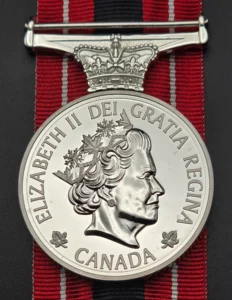 Boulogne Eastern Cemetery, Boulogne, France. A photograph of his brothers Lewis, Gordon and Leonard is at the base of Lloyd’s headstone.


Leave a Reply