


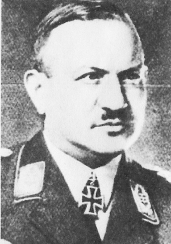
Haase, Konrad, born 29-08-1888 in Dresden,  joined the Army as a Fahnenjunker in the 12th Field Artillery Regiment on 30-03-1908, age 19. Haase was in the fields of the first war and ended as an Adjutant of Artillery Command 140 and retired on 19-04-1920. Konrad joined the Police Service, but reactivated in the growing Reichswehr
  on 15-10-1935, as commander of the 1st Battalion of the 11th Infantry Regiment. With the outbreak of World War II he was commander of the 11th Infantry Regiment until 01-12-1939, under Generaloberst Gerd von Rundstedt.

 Haase was following commander of the 164th Infantry Division
 to 10-01-1940 and commander of the Rear Army Area Tarnow, until 10-03-1940.
  t Commander of the 365th Infantry Division and Senior Field Command 365 to 10-1940. Assigned as commander of the 302nd Infantry Division and in the Führer Reserve (see Adolf Hitler) (did you know), from 16-11-1942 to 20-04-1942. The 302nd Infantry Division was raised in November 1940 from men in Militsry District 3 and was used mostly as a French-occupying force, with some elements remaining in Germany. Its first combat situation was Louis Mountbatten
 Dieppe Raid of 1942
joined the Army as a Fahnenjunker in the 12th Field Artillery Regiment on 30-03-1908, age 19. Haase was in the fields of the first war and ended as an Adjutant of Artillery Command 140 and retired on 19-04-1920. Konrad joined the Police Service, but reactivated in the growing Reichswehr on 15-10-1935, as commander of the 1st Battalion of the 11th Infantry Regiment. With the outbreak of World War II he was commander of the 11th Infantry Regiment until 01-12-1939, under Generaloberst Gerd von Rundstedt. Haase was following commander of the 164th Infantry Division to 10-01-1940 and commander of the Rear Army Area Tarnow, until 10-03-1940. t Commander of the 365th Infantry Division and Senior Field Command 365 to 10-1940. Assigned as commander of the 302nd Infantry Division and in the Führer Reserve (see Adolf Hitler) (did you know), from 16-11-1942 to 20-04-1942. The 302nd Infantry Division was raised in November 1940 from men in Militsry District 3 and was used mostly as a French-occupying force, with some elements remaining in Germany. Its first combat situation was Louis Mountbatten Dieppe Raid of 1942
 Of the nearly 5.000 Canadian soldiers, more than 900 were killed, about 18 percent and 1.874 taken prisoner (37%).
  Fighter Commands indicates that losses amounted to 106 from enemy action: 88 fighters (including 44 Spitfires) 10 reconnaissance aircraft and eight bombers, and that 14 other RAF aircraft were struck off from other causes such as accidents. Other sources suggest that as many as 28 bombers were lost, and that the overall figure for destroyed and damaged Spitfires was 70. Against this, 48 were lost. Included in that total were 28 bombers, half of them Dornier DO 217’s from Kampfgeschwader 2
  . One of the two Jagdgeschwader, JG 2 under Oberstleutnant, Walter “Gulle” Oesau, lost 14 Fw 190s and eight pilots killed. JG 26 under Oberstleutnant Johannes Seifert
  lost six Fw 190s with their pilots. Seifert collided with a P-38, and crashed, age 28, on 25-11-1943, over Béthune, France. Presumably knocked out or severely injured in the collision, Seifert hadn’t made an effort to bale out and his body was found in the wreckage still strapped in. The 302nd‘s actions during the raid led to it being nicknamed the “Dieppe division”. The Germans decided to reward the town of Dieppe for not helping in the raid by freeing POWs originating and living pre-war in Dieppe in their custody, and on 12 September, a train carrying around 1.500 French POWs arrived at Dieppe. In addition, as a reward for what he called the town residents’ “perfect discipline and calm”, Hitler gave the town a gift of 10 million francs, to be used to repair damage caused during the raid. Decimated during the Dnieprenieper- Carpathian Offensive, the 302nd Division was disbanded and those few survivors were transferred to the 15th and the 75th Infantry Divisions, under Generalleutnant der Infanterie, Erich Buschenhagen
 and the 75th Infantry Division
  , under Generalleutnant der Infanterie, Helmuth Beukemann
  . Beukemann died age 87, on 13-07-1981, in Hamburg. General with Special Duties for the army Patrol Service of Army Group South to 10-05-1943 as Haase landed in hospital with an illness to 21-07-1943. He became General with Special Duties for the Army Group B to 26-11-1943, under Generalfieldmarschall der Panzertruppe, Erwin Rommel.
  Haase’s last command was a General with Special Duties and commander of Order Troops with the Staff of the Army Group C, in Italy under Generalfeldmarschall der Flieger, Albert Kesselring,
 until his captivity on 23-05-1945.
Death and burial ground of Haase, Konrad.
 Released on 08-07-1947, he lived in Hahnstätten, where he at the age of 74 died, on 25-01-1963 and is buried with his wife Minna Luise, born Hockelmann, who died age 61 on 17-02-1960, on the village cemetery of Hahnstätten.

Message(s), tips or interesting graves for the webmaster: robhopmans@outlook.com




Leave a Reply