






Manstein, Erich von, “von Lewinski”, born on 24-11-1887 in Berlin  , Joseph Goebbels

 was Gauleiter of Berlin, was the tenth child of West Prussian aristocrat and an Artillery General, Eduard von Lewinski
  .and the fifth child of of von Lewinski second wife Helene, born Sperling. Erich was then adopted after the death of his parents, by his uncle Generalleutnant Georg Albrecht Ernst von Manstein,


Erich’s father Eduard and his brother Albert von Lewinski both received the Pour le Merite  and father Eduard was later a General. Erich’s mother was a daughter of Generalmajor Oskar von Sperling
  and a cousin of von Sperling was the later Fieldmarshal and Reichspresident Paul von Hindenburg
.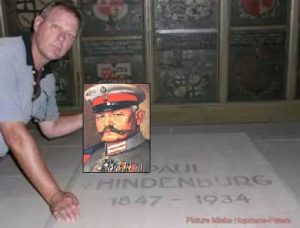

 who married Gertrud von Sperling
Erich von Manstein began his military career in 1906, as an Ensign serving with 3rd Foot Guard Regiment. In 1914, he rejoined 3rd Foot Guard Regiment and then served as Adjutant of 2nd Guard Reserve Regiment. During World War I, Erich von Manstein served on both the Western and Russian front. While fighting on the Russian Front, he was wounded  and afterwards was transferred to the staff of Army Group commander, followed by other staff positions. In 1915, Von Manstein was promoted to the rank of Captain and remained as staff officer until the end of the war in 1918. In 1918, he volunteered for the staff position in Frontier Defence Force in Breslau, Wroclaw and served there until 1919. In 1936, Erich von Manstein was promoted to the rank of Generalmajor, his aide was Hauptmann Alexander Stahlberg

 and became deputy Chief of Staff to General Fedor von Bock.
 Alexander Stahlberg remembered that while waiting to meet with the Fuhrer on 13-07-1943, von Manstein suggested that they take a swim in one of the many beautiful lakes close by FHQ in East Prussia. Neither had their swim trunks. However, no one was around so into the lake they went stark naked and had a most enjoyable swim. When they begin to swim back toward the ladder of the small footbridge they had used to enter the lake, young Stahlberg spotted a half a dozen men on the footbridge. Von Manstein asked if any of them were women and Stahlberg said he did not think so.
When they got to the base of the ladder Stahlberg got a better look (von Manstein was virtually blind without his glasses) and said, “I believe, sir, that it is Field Marshal Erwin Rommel.

 ”“You’re right. my dear fellow, this is Field Marshal Rommel!”“Then there was a big hello from below and above, and Manstein shouted, ‘so we meet at last!’ It was true: Von Manstein and Rommel had never met until that moment…Rommel spoke again from above: ‘Well gentlemen, why don’t you come up?’ And von Manstein called back: ‘Yes, why not?’ And so, mother naked, we climbed the rungs until we were standing before the well-dressed officers.”
Stahlberg became a member of the Claus Graf Schenck von Stauffenberg 
 and Stauffenberg’s cousin Generalmajor Henning von Tresckow resistance group, but he survived the war and died age 82 on 09-01-1995 at Schloss Bloemersheim in Gartow.
Von Manstein in 1938, took part in the German take-over of the Sudetenland as the Chief of Staff to General Wilhelm von Leeb 
 . On 01-04-1939, von Manstein was promoted to the rank of Lieutenant-General.In 1939, Erich von Manstein served as Chief of Staff to General Gerd von Rundstedt,
 who commanded Army Group South during the Invasion of Poland in September. In preparations for the Invasion of France, Erich von Manstein received the position of Chief of Staff of the Army Group A. On 06-02-1940, he received the command of 38th Infantry Corps, which he successfully commanded in France and was first across the River Seine and later proposed his own new plan of the attack on France based on the Blitzkrieg. First his plan Operation, sickle- stroke, was rejected by the German Army’s High Command, but once it was brought to Hitler’s personal attention on 07-07, it was quickly accepted. During the French Campaign, Erich von Manstein was promoted to the rank of General and on 19-06-1940, after the success of Fall Gelb, he was awarded the Knight’s Cross. In February of 1941, von Manstein advanced over 320 km, while capturing bridges across Duna River and almost capturing the city of Leningrad. On September 12/13th of 1941, von Manstein received the command of 11th Army
  , where he succeeded Generaloberst der Infanterie, Eugen von Schobert,

 who crashed near the Dnjepr in a Russian mine field, age 58. Von Manstein then successfully drove southwards into the Crimea, while taking over 430.000 Russian prisoners and by November 16th secured entire Crimea with exception of Sevastopol. On 01-07-1942, he captured the city of Sevastopol, and on the same day received the promotion to the rank of Field Marshal. Von Manstein married Jutta Sibylle von Loesch, the daughter of a Silesian landowner, in 1920. He proposed marriage after having known her for only three days. They had three children: a daughter, Gisela (born 1921)
 , and two sons, Gero (born 1922)
  and Rüdiger (born 1929)
  . His son Gero was killed in Russia, age 19, on 23-10-1942, near the Lake Ilmen, Gero was described by his father as delicate from birth as an asthma sufferer but determined to get over his difficulty to be a soldier. Von Manstein’s daughter Gisela was married too Major Edel-Heinrich Zachariae-Lingenthal
  , a highly decorated Major im Generalstab in the Wehrmacht who served as commander of II. / Panzer-Regiment 15,
  . under General Hermann Balck.
 Zachariae-Lingenthal survived the war and died in Bad Honnef, age 81 on 30-03-1998.
. This picture was taken shortly before Gero’s death. 
Erich von Manstein received the command of newly formed Army Group Don ![Hitler begrüßt Generalfeldmarschall von Manstein auf einem Feldflugplatz im Osten 1943 [freigegeben am 18.3.1943]](https://ww2gravestone.com/wp-content/uploads/2015/10/Erich-Von-Manstein-300x201.jpg) , which was made up of Generaloberst der Waffen SS, Hoth’s 4th Panzer Army, Hermann Hoth
, which was made up of Generaloberst der Waffen SS, Hoth’s 4th Panzer Army, Hermann Hoth

 . Friedrich Paulus‘s
  6th Army
  , entirely trapped in Stalingrad and 3rd Romanian Army, commanded by General Petre Dumitrescu
  , Dumitrescu survived the war and died of natural causes at his Bucharest home on 15-01-1950, age 67 in Bucharest..
Von Manstein was ordered to relieve the 6th Army and 4th Panzer Army trapped in the city of Stalingrad. Von Manstein started his attack on December 12th and by 24th was within 50 km from “Fortress Stalingrad”, when his advance was halted and he was forced into 200 km long retreat, which continued until February of 1943. During the “Unternehmen Zitadelle”, von Manstein’s Army Group South made good progress but was eventually halted when 4th Panzer Army was unable to advance northwards. This was a result of the unresolved outcome of the biggest tank battle in history on 12-07-1943 in the area of Prochorovka, where SS Obergruppenfuhrer Paul “Papa” Hausser‘s 

 II SS Panzer Corps engaged Lieutenant-General Pavel Rotmistrov’s
 5th Guards Tank Army. Pavel Rotmistroy.died age 80 on 06-04-1982. From October to mid January of 1944, von Manstein “stabilized” the situation but in late January was forced to retreat further westwards by the new Soviet offensive. He received the Oalleaves and Swords on 30-03-1944 In mid February of 1944, von Manstein disobeyed Hitler’s order and ordered 11th and 42nd Corps, consisting of 56000 men in six divisions of his Army Group South to breakout from the “Cherkassy Pocket”, which occurred on February 16/17th. Eventually, Hitler accepted this action and ordered the breakout after it already took place. On 30-03-1944, Erich von Manstein was dismissed by Adolf Hitler after the series of “heated” conferences over the situation and decisions made concerning the events on the Eastern Front. Model’s adjutant, Günther Reichhelm
  , later described the scene and Manstein’s response: He must have paid him compliments about his strategic skills during the attack operations, but he also said, “I cannot use you in the South. Field Marshal Walter Model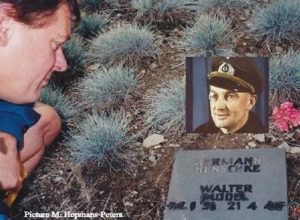
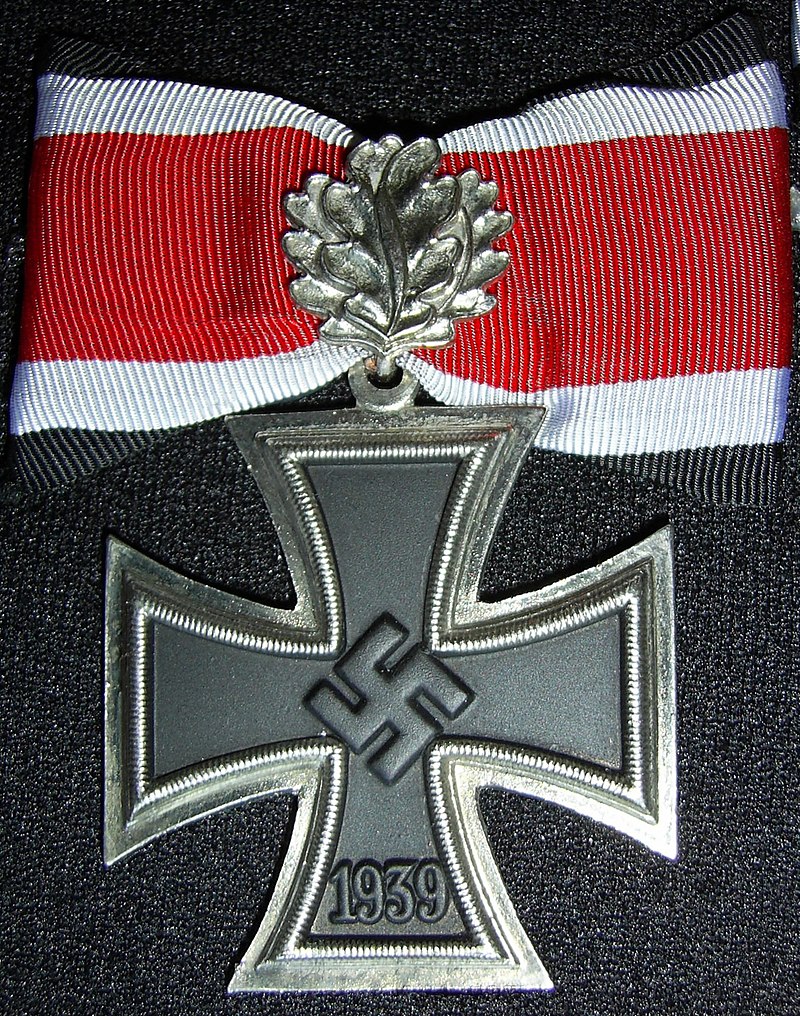
 will take over.” and Manstein replied, “My Führer … please believe me when I say I will use all strategic means at my disposal to defend the soil in which my son lies buried.” On the same day, von Manstein received the Swords to the Oak Leaves of the Knight’s Cross
  . Von Manstein detested Herman Göring and damned Heinrich Himmler

 and to his most trusted collegues he had admitted to have Jewish ancestors. For the fun he had trained his dachshund Knirps to raise his leg at the command “Heil Hitler” Von Manstein’s wife Jutta on the other hand was a fanatic Hitler admirer.
Unlike most historical figures, von Manstein was recognized in his own time as Germany’s greatest Field Marshal. It was thought by key anti-Hitler plotters in the German Army, that only von Manstein had the prestige to lead an army revolt against the Nazi Party. Except for the thoroughly Nazified Field Marshals such as Model, all the others would have followed his orders.
At the time of his brief meeting with the Fuhrer mentioned in the beginning of the post, Field Marshal Günther “Hans” Kluge 
 was also present. Later in the evening, after their usual meeting with Hitler where he refused their advice, the three Field Marshals retired to their common quarters and sat up over several bottles of red wine. Stahlberg was present as he always was at every meeting or social gathering at von Manstein’s insistence.
In front of Rommel, Kluge said to von Manstein, “Manstein, the end will be bad, and I repeat what I told you earlier: I am prepared to serve under you.” With that, Kluge retired. Over a few more glasses of wine, Rommel also told Manstein that the war would end in a total catastrophe and further should the Allies land in Europe, the entire German state and military would quickly reach a point where it would collapse like a house of cards.Then Rommel stood to take his leave and von Manstein stood to shake his hand. Said Rommel, “I, too, am prepared to serve under you.”
Manstein nicknamed “The Pisspot Strategist” Hitler couldnt afford to be rid of von Manstein. But as his loyalty became obviously more threadbare, Hitler looked for an excuse, and found it after Kursk, when he bestowed this moniker.
Death and burial ground of Manstein, Erich von “von Lewinski” “The Pisspot Strategist”.


After his dismissal, Erich von Manstein entered the Breslau hospital’s eye clinic followed by convalescence near Dresden and then retired to his estate. Although, he did not take part in the attempt to kill Hitler on July 20th of 1944, he was aware of it. In late January of 1945, von Manstein collected his family members from their homes in Liegnitz (Legnica) and evacuated them to Celle in West Germany. In May of 1945, Erich von Manstein was arrested by the British Forces and taken to POW camp in Luneburg and later to Nuremburg. In the Autumn of 1946, he was transferred to the special camp for high ranking officers in Great Britain and returned to Germany in the Summer of 1948. During the war crimes trial in August of 1949, Erich von Manstein was sentenced for 18 years of imprisonment but was released in 1952, because of his health condition. Erich von Manstein also successfully defended number of Wehrmacht officers charged with war crimes. Afterwards, in 1956, he became an organizational adviser to the Bundeswehr, joined with Germany’s wartime enemies to protect Western Europe from Soviet threat.
Erich von Manstein lived with his family, including his son Rudiger, in Irschenhausen near Icking (see Friedrich Sixt) (see Josef Dahme) in the Isar valley in Bavaria until he died by a cerebral apoplexy at the age of 85, on 10-06-1973. He is buried with his wife Jutta Sibylle, born Loesch, who died old age 64, 01-03-1966, in Dorfmark near Fallingbostel. Close by the graves of General der Infanterie, Bruno Bieler and Generalmajor der Infanterie, Egmond Bahn.


Message(s), tips or interesting graves for the webmaster: robhopmans@outlook.com


Leave a Reply