

 the son of the lawyer Hugo Kaltenbrunner and his wife Therese Kaltenbrunner-born Udwardy. Father and mother Kaltenbrunner were anti-church and proponents of the integration of Austria into Greater Germany.Ernst educated at the State Realgymnasium in Linz and at Graz University. Raised in a nationalist family, he was childhood friends with Adolf Eichmann,
 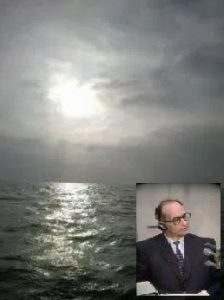 the infamous SS officer who played a key role in implementing the Nazis’ “Final Solution” against Europe’s Jews He obtained a law degree in 1926 and briefly worked as a lawyer in Linz and Salzburg. He was a very tall man, standing just over 6′ 7″ (201 cm) tall and had deep scars on his face from dueling in his student days. However, according to some sources, these “dueling scars” were actually the result of an alcohol-related driving accident. Kaltenbrunner
  joined the Nazi Party
  NSDAP-nr.: 300 179, on 18-10-1930, and his NSDAP
  . In 1932, he joined the SS in Austria
  . His SS number was 13,039, on 31-08-1931. He was the Gauredner, district speaker and Rechtsberater, legal consultant, of the SS Division VIII. In January 1934, Kaltenbrunner was briefly jailed by the Engelbert Dollfus
 government with other National Socialists at the Kaisersteinbruch concentration camp. In 1934, he was jailed again on suspicion of High Treason in the assassination of Dollfuss. This accusation was dropped, but he was sentenced to six months for conspiracy. In 1934, Kaltenbrunner married Elisabeth “Erna” Eder
  (born 1908) and they had three children. In addition to the children from his marriage, Kaltenbrunner had twins, Ursula and Wolfgang, born 1945, with his long-time mistress Gisela Gräfin von Westarp, born Wolf.
  All of his children survived the war. She died on 02-06-1983 in München, Bayern, Germany, she was 62 years old.
 He assisted in the Anschluss and Adolf Hitler (did you know) promoted him to SS Brigadeführer
  on the day the Anschluss
  was completed. On 11-09-1938 he was promoted to the rank of SS Gruppenführer
  . He was also a member of the Reichstag from 1938. Kaltenbrunner, in 1939, was one of the few to receive the “Golden Party Badge” for old comrades.
  Adolf Hitler’s own Golden Party Badge had the number ‘1’. He awarded it to Magda Goebbels
 (see Did you know) on 27-04-1945, less than 48 hours before he committed suicide in his Führerbunker. She called it “The greatest honour any German could receive”. It was awarded to her for being “The Greatest Mother in the Reich”. The ‘1’ badge was stolen from a display in Russia in 2005. The guards thought that a cat had set off the alarms and this allowed the burglar to escape. In July 1940, Kaltenbrunner was commissioned as a Untersturmführer in the Waffen-SS Reserve. Later in April 1941, he was promoted to Generalmajor of the Police. On 30-01-1943 Kaltenbrunner was appointed Chief of the RSHA,
  composed of the SiPo, Sicherheitspolizei: the combined forces of the Gestapo and Kripo, along with the SD , Sicherheitsdienst: Security Service). He replaced Reinhard Heydrich,

 who was assassinated in June 1942. Kaltenbrunner held this position until the end of the war. He a friend of SS Obersturmbannführer, Adolf Eichmann
 was promoted to SS Obergruppenführer
  und General der Polizei on 21-06-1943. He also replaced Heydrich as President of the International Criminal Police Commission, ICPC, the organization today known as Interpol. Toward the end of the war, Kaltenbrunner’s power increased greatly, especially after the attack on Hitler of 20 July 1944, Claus Graf Schenk von Stauffenberg and Nina


 upon which he gained direct access to the Führer. He was also responsible for conducting kangaroo trials and calling for the execution of all the people who were accused of plotting against Hitler. It was often said that even Reichsführer SS, Heinrich Himmler
 feared him and he managed to be an intimidating figure with his height, facial scars and volatile temper. It was rumored that he was responsible for Adolf Eichmann’s
  failure to attain the rank of SS-Colonel. Kaltenbrunner was also long-time friends with SS Obersturmbannführer, Otto Skorzeny

 and recommended him for many secret missions, allowing Skorzeny to become one of Hitler’s valued agents. Kaltenbrunner was also responsible for heading Operation Long Jump, the attempt to assassinate Josef Stalin,
 Winston Churchill,
  and Theodore “Teddy” Roosevelt.
 Following Himmler’s appointment as Minister of the Interior in August 1943, Kaltenbrunner sent him a letter wherein he argued that Himmler’s new powers must be used to reverse the party cadre organization’s annexation.
 Kaltenbrunner, as spectator at a People’s Courtshow trial following the failed 20 July plot. In December 1944, Kaltenbrunner was granted the rank of General of the Waffen SS. On 09-12-1944 he was awarded the Knights Cross of the War Merit Cross with Swords
  . In addition he was awarded the Golden NSDAP party badge and the Blutorden. On 18-04-1945, Himmler named Kaltenbrunner Commander-in-Chief of those remaining German forces in Southern Europe. Kaltenbrunner reorganized his intelligence agencies as a stay-behind underground net. He divided the subcommands between Otto Skorzeny, head of the sabotage units, and Wilhelm Waneck, who kept in contact not only with Kaltenbrunner and other centers in Germany, but also with stay-behind agents in the southern European capital. In late April 1945, Kaltenbrunner fled his headquarters from Berlin to Altaussee, where he had often vacationed and had strong ties. On 12-05-1945 he was captured by a U.S. patrol and arrested. At the Nuremberg Trials, Kaltenbrunner was charged with conspiracy to commit crimes against peace, war-crimes and crimes against humanity. The most notable witness in this trial was Rudolf Höss,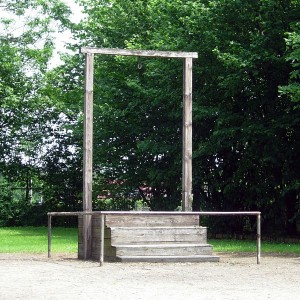

 the camp commander of the Auschwitz concentration camp. Höss was hanged in his own concentration camp next to his house there, age 46, on 16-04-1947. Kaltenbrunner’s close control over the RSHA meant that direct knowledge of and responsibility for the following crimes were ascribed to him: Mass murders of civilians of occupied countries by Einsatzgruppen and screening of prisoner of war camps and executing racial and political undesirables. On 30-09-1946 the IMT found Kaltenbrunner not guilty in matters of conspiracy for aggression concerning the charge of the indictment.


Death and burial ground of Kaltenbrunner, Ernst.


However, Kaltenbrunner was found guilty of war crimes and crimes against humanity. On 01-10-1946 the court sentenced Ernst Kaltenbrunner to death by hanging. Kaltenbrunner was executed by hanging by the US hangman John Chris Woods at around 1:40 a.m. on 16-10-1946. Kaltenbrunner’s last words were: I have loved my German people and my fatherland with a warm heart. I have done my duty by the laws of my people and I am sorry this time my people were led by men who were not soldiers and that crimes were committed of which I had no knowledge.  Germany, good luck. Kaltenbrunner and all ten condemned men, Joachim von Ribbentrop, Julius Streicher, Hans Frank, Fritz Sauckel, Arthur Seyss Inquart, Ferdinand Jodl,
  Wilhelm Keitel, Alfred Ernst Rosenberg, Wilhelm Frick, and Hermann Göring, who committed suicide only hours before his hanging, were secretly transferred in American army trucks to Munich on 16-10-1946. Cremated in the Ostfriedhof of Munich and again secretly in the same night, scattered in the river Isar, from the Reichenbachbrücke, only one mile near the East cemetery.


Message(s), tips or interesting graves for the webmaster: robhopmans@outlook.com


Leave a Reply